
Learning outcomes. theoretical
|
|
|
- Albert Bosmans
- 10 jaren geleden
- Aantal bezoeken:
Transcriptie
1 Learning outcomes theoretical accountancy education 2008 This document is in English as from paragraph 2.5, page Betreft : Dutch learning outcomes theoretical accountancy education Auteur : Commissie Eindtermen Accountantsopleiding Datum : november 2007 Versie : 2008/update 202/.4 Dutch learning outcomes theoretical accountancy education, version 2008, update 202/.4

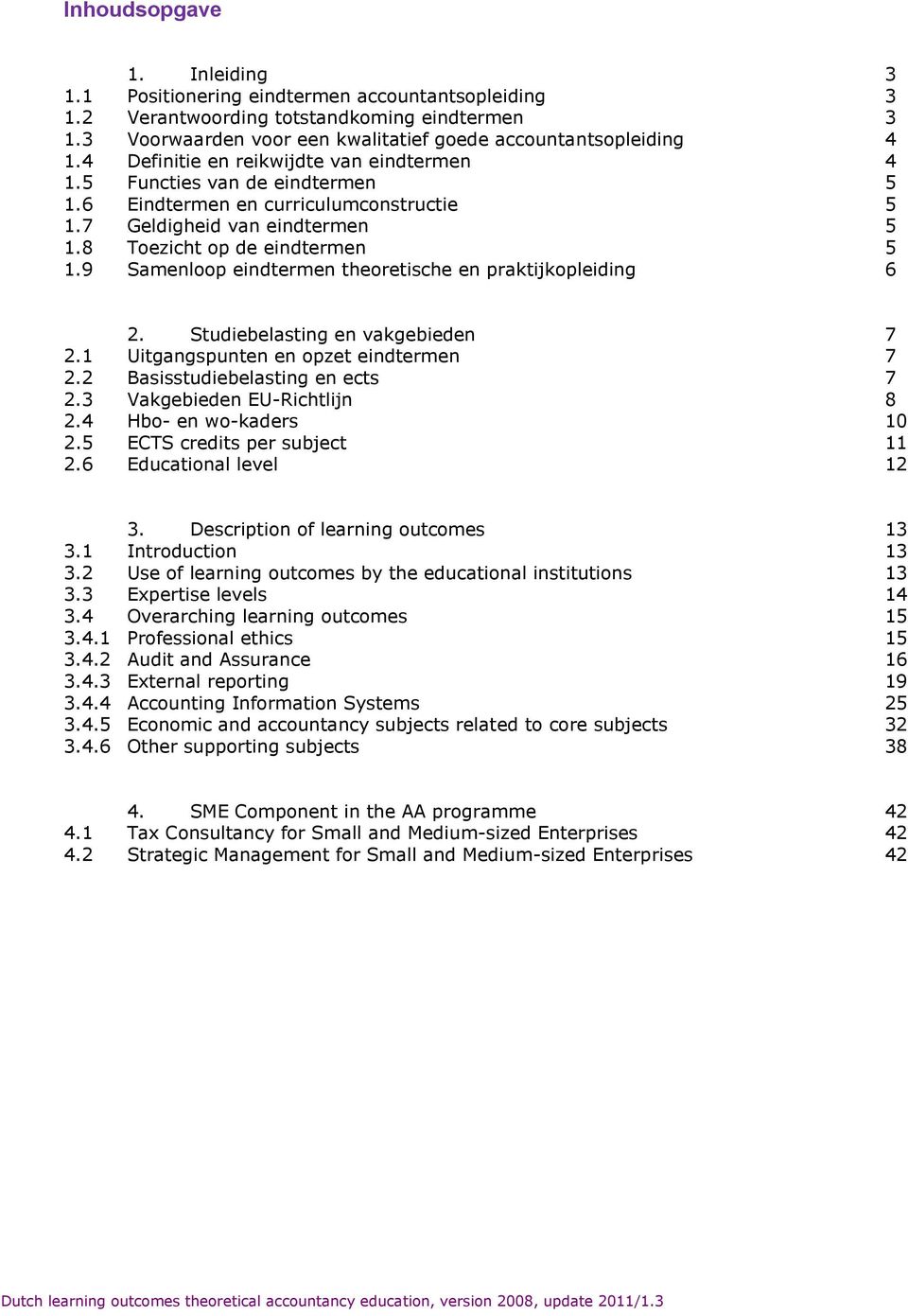
2 Inhoudsopgave. Inleiding. Positionering eindtermen accountantsopleiding.2 Verantwoording totstandkoming eindtermen. Voorwaarden voor een kwalitatief goede accountantsopleiding 4.4 Definitie en reikwijdte van eindtermen 4.5 Functies van de eindtermen 5.6 Eindtermen en curriculumconstructie 5.7 Geldigheid van eindtermen 5.8 Toezicht op de eindtermen 5.9 Samenloop eindtermen theoretische en praktijkopleiding 6 2. Studiebelasting en vakgebieden 7 2. Uitgangspunten en opzet eindtermen Basisstudiebelasting en ects 7 2. Vakgebieden EU-Richtlijn Hbo- en wo-kaders ECTS credits per subject 2.6 Educational 2. Description of learning outcomes. Introduction.2 Use of learning outcomes by the educational institutions. Expertise s 4.4 Overarching learning outcomes 5.4. Professional ethics Audit and Assurance 6.4. External reporting Accounting Information Systems Economic and accountancy subjects related to core subjects Other supporting subjects 8 4. SME Component in the AA programme Tax Consultancy for Small and Medium-sized Enterprises Strategic Management for Small and Medium-sized Enterprises 42 Dutch learning outcomes theoretical accountancy education, version 2008, update 20/.
3 . Inleiding Dit rapport bevat de eindtermen voor de theoretische opleiding tot accountantadministratieconsulent en registeraccountant, zoals vastgesteld door de Commissie Eindtermen Accountantsopleiding in haar vergadering van 20 november Nadere informatie over het tijdstip en de termijn van invoering wordt afzonderlijk aan de opleidingen verstrekt.. Positionering eindtermen accountantsopleiding Als gevolg van de invoering van de Wet toezicht accountantsorganisaties (Wta) per oktober 2006 is de Commissie Eindtermen Accountantsopleiding (CEA) ingesteld. De CEA heeft onder meer tot taak het vaststellen van de (theoretische en praktijk) eindtermen van de accountantsopleidingen in Nederland. Daarnaast wijst de CEA opleidingen aan die geheel of gedeeltelijk voldoen aan de eindtermen en toetst zij de mate waarin aan de eindtermen van de praktijkopleiding wordt voldaan. De Wta regelt het toezicht op accountantsorganisaties en individuele accountants die wettelijke controles uitvoeren. Met dit toezicht beoogt de wetgever het vertrouwen in de accountant en de kwaliteit van de door hem 2 ten behoeve van het publiek gegeven verklaringen te borgen. Naast het toezicht op het functioneren van accountantsorganisaties en accountants is bij invoering van deze wet ook het toezicht op de accountantsopleidingen in Nederland herzien. De opleiding tot accountant-administratieconsulent (AA) en registeraccountant (RA) bestaat uit een theoretische opleiding en een praktijkopleiding. Een kandidaat kan alleen ingeschreven worden in het register van de Nederlandse Orde van Accountants-Administratieconsulenten (NOvAA) of het Koninklijk Nederlands Instituut van Registeraccountants (NIVRA) als hij een opleiding heeft gevolgd, waarbij moet zijn voldaan aan de door de CEA vastgestelde eindtermen. De eindtermen vormen vervolgens de norm om de kwaliteit van de accountantsopleiding vorm te geven en te bewaken..2 Verantwoording totstandkoming eindtermen De vastgestelde eindtermen zijn gebaseerd op het rapport van juni 2007 van de door de CEA ingestelde Adviescommissie Eindtermen (ACE) onder voorzitterschap van prof. J.C.A. Gortemaker RA. Deze commissie had als opdracht de eindtermen te beschrijven voor de accountant belast met de wettelijke controle van jaarrekeningen en geconsolideerde jaarrekeningen volgens de EU-richtlijn (2006/4/EG) met aandacht voor de natuurlijke adviesfunctie. Tevens is verzocht daarbij de beroepsprofielen van NOvAA en NIVRA te betrekken om vervolgens te komen tot globale, toetsbare eindtermen. In de adviescommissie zaten vertegenwoordigers van de belangrijkste stakeholders, te weten: wetenschappelijk onderwijs (wo), bekostigd en particulier hoger beroepsonderwijs (hbo) en de beide beroepsorganisaties NOvAA en NIVRA. De adviescommissie heeft bij het beschrijven van de eindtermen relevante (internationale) documentatie betrokken. De adviescommissie heeft tevens kennis genomen van conceptstukken terzake toekomstige onderwijsontwikkelingen. Nadat de adviescommissie haar adviesrapport had uitgebracht heeft de CEA aan alle stakeholders een reactie gevraagd. Dit waren: AC-scholenoverleg, HBO-raad, VAAC, PWA, NOvAA en NIVRA. Ook heeft de CEA enkele personen uit het hbo- en wo-onderwijs uitgenodigd om op persoonlijke titel op het adviesrapport te reageren. De CEA heeft de reacties intensief besproken en waar mogelijk in bijgaande eindtermen verwerkt. Voor zover deze opleidingen niet zijn geaccrediteerd overeenkomstig artikel 5.0 Whw 2 Voor de leesbaarheid is gekozen voor de mannelijke vorm. Waar hij staat kan ook zij gelezen worden. Dutch learning outcomes theoretical accountancy education, version 2008, update 202/.4.0
4 . Voorwaarden voor een kwalitatief goede accountantsopleiding Voor het bereiken en in stand houden van een kwalitatief goede accountantsopleiding moeten naar het oordeel van de CEA enkele essentiële voorwaarden vervuld zijn. Deze voorwaarden zijn achtereenvolgens: o kwalificatie-eisen (geformuleerd als eindtermen); o een curriculum (structuur en inhoud van de opleiding); o onderwijsprogramma s, gebaseerd op onderwijsleerdoelen; o regelingen aangaande toetsing, evaluatie en selectie; o interne kwaliteitsbewaking (evaluatie van onderwijs en docenten); o externe kwaliteitstoetsing (visitatie/accreditatie en beleidsgesprekken/aanwijzingen); o aandacht voor permanente curriculumbijstelling en ontwikkeling; o systematische deskundigheidsbevordering van docenten en examinatoren..4 Definitie en reikwijdte van eindtermen In het onderwijs zijn eindtermen de operationalisatie van de kwalificatie-eisen, waaraan voldaan moet zijn om het diploma, waar een voltooide opleiding recht op geeft, te verwerven. Zij omvatten een concrete beschrijving van de kenmerken van het eindproduct van een opleiding. Eindtermen geven antwoord op de vraag wat een persoon die de opleiding heeft afgerond, weet, kan en kan uitvoeren. Er is bewust voor gekozen om één set eindtermen voor zowel de opleiding tot accountantadministratieconsulent als registeraccountant te ontwerpen. De reden hiervoor is dat beide beroepsbeoefenaren dezelfde bevoegdheid hebben wettelijke controles van jaarrekeningen uit te voeren. Algemeen wordt erkend dat de accountant-administratieconsulent en registeraccountant deels elk een eigen markt(segment) bedienen en een specifiek op die markt toegesneden productportfolio aanbieden. Daarom wordt in de eindtermen ruimte gelaten verschillen in marktsegment en beroepsprofiel tot uitdrukking te brengen. Voorop staat echter dat de wettelijke controle van de jaarrekening uitmondend in een accountantsverklaring, aan dezelfde wet- en regelgeving dient te voldoen. Elke beroepsbeoefenaar die gerechtigd is om wettelijke controles uit te voeren moet daarom voldoen aan de basiseisen die zijn verwoord in de eindtermen. De eindtermen zien op de beginnende beroepsbeoefenaar. Dit betekent dat van een afgestudeerde accountant-administratieconsulent en registeraccountant niet verwacht mag worden dat deze zelfstandig in alle situaties alle soorten van opdrachten kan uitvoeren. De accountant-administratieconsulent en registeraccountant hebben beiden een eigen verantwoordelijkheid, die in de geldende beroepsregels is verankerd, om voor elke opdracht/situatie afzonderlijk te beoordelen of en op welke wijze zij deze kunnen uitvoeren. De eindtermen beschrijven primair de eisen die gesteld worden aan de wettelijke controle van jaarrekeningen en geconsolideerde jaarrekeningen, inclusief de daaruit voortvloeiende natuurlijke adviesfunctie. Secundair zien de eindtermen op de bredere functie van de accountant-administratieconsulent en registeraccountant. De eindtermen beschrijven echter niet het volledige beroepsprofiel van de accountant-administratieconsulent en registeraccountant op hetzelfde eindniveau als voor de functie van wettelijk controleur van jaarrekeningen. De CEA is van mening dat de vastgestelde eindtermen ook dienstbaar zijn aan de andere functies dan die van de wettelijke controle van jaarrekeningen van de accountant-administratieconsulent en registeraccountant. Het is aan de onderwijsinstellingen zelf om hier verder vorm en invulling aan te geven, zonder uiteraard de realisatie van de eindtermen voor de wettelijk controleur daarmee in gevaar te brengen. Dat biedt onderwijsinstellingen bij uitstek de mogelijkheid om de opleiding een eigen kleur en identiteit te geven en zich daarmee, indien gewenst, te onderscheiden van andere accountantsopleidingen. Dutch learning outcomes theoretical accountancy education, version 2008, update 202/.4.0 4
5 .5 Functies van de eindtermen De eindtermen voor de accountantsopleiding vervullen verschillende functies. Allereerst geven de eindtermen richting en sturing aan de inhoud van de accountantsopleidingen, waardoor de kwaliteit geborgd wordt. De eindtermen vormen tevens de kern van de domeinspecifieke aspecten van het toetsingskader voor de accreditatie van opleidingen door de NVAO en voor het aanwijzen van opleidingen door de CEA (zie ook paragraaf.8 Toezicht op de eindtermen). Ook bieden de eindtermen de mogelijkheid tot het maken van landelijk bruikbare onderwijsprogramma s en landelijke toetsen. In het bijzonder de landelijke toetsing draagt bij aan het borgen van de minimumkwaliteit van de opleiding, welke eis de CEA heeft gesteld voor het verkrijgen van een aanwijzing. Tot slot zijn de eindtermen van belang in het kader van de verklaring van vakbekwaamheid die de CEA afgeeft. Zo zijn de betreffende eindtermen ook van toepassing op de examens Nederlands recht en gedrags- en beroepsregels die op grond van artikel 57 Waa en artikel 78 Wra verplicht zijn voor personen van binnen de EU/EER die een verklaring van vakbekwaamheid willen verkrijgen. Daarnaast zijn de eindtermen relevant voor de beoordeling van de vergelijkbaarheid van diploma s van personen van buiten de EU/EER die een verklaring van vakbekwaamheid willen verkrijgen..6 Eindtermen en curriculumconstructie De eindtermen van de accountantsopleiding zoals vastgesteld door de CEA, vormen de basis voor het curriculum van de accountantsopleidingen in Nederland. De eindtermen zijn te kwalificeren als minimumnorm voor de accountantsopleiding. Elke onderwijsinstelling of organisatie die een accountantsopleiding aanbiedt of wil gaan aanbieden, is verantwoor-delijk voor het inrichten van een adequaat curriculum voor de eigen accountantsopleiding. Instellingen dienen de eindtermen te vertalen naar onderwijsleerdoelen die uitmonden in een coherent onderwijsprogramma en literatuuropgave. In de tentamens en examens dienen de eindtermen op een juiste en evenwichtige wijze aan bod te komen. Het staat instellingen vrij om naast de vastgestelde eindtermen aanvullende eindtermen in het curriculum op te nemen of de vastgestelde eindtermen op een hoger niveau op te nemen. Hierdoor bestaat de mogelijkheid van intensivering en specialisatie binnen het curriculum..7 Geldigheid van eindtermen De hier beschreven eindtermen zijn naar hun aard statisch en daarom kwetsbaar voor onvermijdelijk optredende veranderingen in de beroepspraktijk en/of wet- en regelgeving. Bij de beschrijving van eindtermen is zoveel mogelijk rekening gehouden met de borging van de actualiteit. Het is echter de verantwoordelijkheid van elke instelling om continu de actualiteit van onderwijsprogramma, onderwijsleerdoelen en literatuur te bewaken en te borgen. De CEA zal jaarlijks de geldigheid en actualiteit van de eindtermen beoordelen en indien nodig updates uitbrengen. Periodiek zullen de eindtermen herzien worden en zal een volledig nieuwe uitgave van de eindtermen uitgebracht worden. Via de website van de CEA is altijd de laatste uitgave van de eindtermen beschikbaar. Ter stimulering en ondersteuning van het permanente proces van actualisering kunnen suggesties ter aanvulling en/of wijzing van de eindtermen via de website van de CEA worden gemeld..8 Toezicht op de eindtermen De opleiding tot AA en RA omvat over het algemeen een initieel deel bij een bekostigde of particuliere onderwijsinstelling waarop de Wet op het hoger onderwijs en wetenschappelijk onderzoek (Whw) van toepassing is en een postinitieel deel dat buiten de werkingssfeer van de Whw valt. Studenten moeten om in aanmerking te komen voor inschrijving in een accountantsregister een theoretische en praktijkopleiding gevolgd hebben die voldoet aan de eindtermen. Dit betekent dat voor de theoretische opleiding het geheel van initiële en postinitiële opleiding tezamen moet voldoen aan de eindtermen van de CEA. Hiervan is alleen sprake als de initiële opleiding is geaccrediteerd door de NVAO en de postinitiële opleiding beschikt over een aanwijzing van de Eindtermen zijn niet hetzelfde als onderwijsleerdoelen. Eindtermen beschrijven het eindproduct van de opleiding, het niveau van functioneren op het moment van kwalificatie. Onderwijsleerdoelen beschrijven de weg waarlangs de eindtermen bereikt (zouden) kunnen worden. Dutch learning outcomes theoretical accountancy education, version 2008, update 202/.4.0 5
6 CEA en de onderwijsprogramma s van beide opleidingen zodanig op elkaar aansluiten dat zij de totale set van eindtermen omvatten. Ten behoeve van de te verstrekken aanwijzingen zal de CEA de samenhang tussen initiële en postinitiële opleiding nadrukkelijk beoordelen. Overigens geldt dat als studenten binnen een studiefase (bachelor, master of postinitieel) overstappen naar een andere onderwijsinstelling, de nieuwe onderwijsinstelling moet vaststellen dat de eindtermen tot aan het moment van overstap zijn behaald mede in relatie tot het eigen curriculum. Bij het toelaten van studenten tot een volgende fase van de accountantsopleiding moet de betreffende onderwijsinstelling vaststellen dat de eindtermen van de eerder gevolgde opleiding nauwgezet aansluiten op de opleiding van de ontvangende onderwijsinstelling. Als niet alle eindtermen afgedekt worden, dient de ontvangende onderwijsinstelling er op toe te zien dat bestaande deficiënties in de eindtermen worden weggewerkt. Omdat de CEA niet rechtstreeks toeziet op de eindtermen in de initiële opleiding zijn er specifieke afspraken gemaakt met de onderwijsinstellingen die zien op de initiële opleiding. Die afspraken luiden: o de CEA voert periodiek beleidsgesprekken met de onderwijsinstellingen die het initiële deel van de opleiding tot AA respectievelijk RA aanbieden; o ten behoeve van de visitaties van de initiële opleidingen voor AA respectievelijk RA worden bij de samenstelling van de leden van het visitatiepanel ten behoeve van de accreditatie door de NVAO in ieder geval die personen gekozen die voorkomen op een lijst van deskundigen van de CEA en wel zodanig dat alle beroepsdisciplines (AA, RA en bedrijfseconomie) in het visitatiepanel zijn afgedekt. De eisen waaraan instellingen moeten voldoen om in aanmerking te komen voor een aanwijzing door de CEA zijn opgenomen in het Reglement aanwijzing opleiding door de CEA. Dit reglement is opgenomen op de website van de CEA. Daarnaast vermeldt de aanwijzingsbeschikking nauwkeurig de voorwaarden die verbonden zijn aan een aanwijzing..9 Samenloop eindtermen theoretische en praktijkopleiding Zoals hiervoor al aangegeven omvat de accountantsopleiding zowel een theoretisch deel als een praktijkdeel. De theoretische opleiding wordt gevolgd bij een of meer onderwijsinstellingen. De praktijkopleiding wordt gevolgd via een door de beroepsorganisaties erkend stagebureau. De verantwoordelijkheid voor de inrichting van de praktijkopleiding en het examen van de praktijkopleiding ligt bij de beroepsorganisaties. De praktijkopleiding heeft primair als doel om vast te stellen of een persoon de theoretische kennis in de praktijk kan toepassen. Over het algemeen volgt een student een gedeelte van de praktijkopleiding gelijktijdig met het laatste deel van de theoretische opleiding. Daardoor bestaat er automatisch een wisselwerking tussen theoretische opleiding en praktijkopleiding die als zeer nuttig wordt ervaren. De CEA is van mening dat de synergie tussen theoretische opleiding en praktijkopleiding zo groot mogelijk moet zijn. Dit wil de CEA tot uitdrukking brengen door de opzet van de eindtermen voor de theoretische opleiding en de praktijkopleiding waar mogelijk gelijk te houden. De CEA beraadt zich op mogelijkheden om de synergie tussen theorie en praktijk, bijvoorbeeld door middel van integratie, in de toekomst verder te optimaliseren. Dit laat onverlet dat de theoretische opleiding ook nu al mogelijkheden hiervoor biedt, bijvoorbeeld door het uitwerken van praktijksituaties in de onderwijsomgeving en de begeleiding van de praktijkscriptie door opleidingen. Dutch learning outcomes theoretical accountancy education, version 2008, update 202/.4.0 6
7 2. Studiebelasting en vakgebieden 2.. Uitgangspunten en opzet eindtermen De eisen voor het theoretische deel van de opleiding tot wettelijk controleur zoals beschreven in de EU-Richtlijn (2006/4) voor wettelijke controles van jaarrekeningen en geconsolideerde jaarrekeningen zijn het uitgangspunt voor de eindtermen. Bij de beschrijving van de eindtermen staat primair de functie van wettelijk controleur en het niveau waaraan het theoretische deel van de opleiding tot wettelijk controleur (gegeven de Richtlijn) ten minste moet voldoen, centraal. De minimaal te realiseren eindtermen, waar het de vakgebieden van de Richtlijn betreft, voor de wettelijk controleur en daarmee voor een AA- en een RA- opleiding, zijn gelijk. Dit betekent dat er één set eindtermen is gedefinieerd voor zowel de AA- als de RA-opleiding. Voor de in de Richtlijn genoemde vakgebieden, waarvan de theoretische kennis in een (AA- of RA-) opleiding getoetst dient te worden, is een basisstudiebelasting vastgesteld. Deze basisstudiebelasting omvat - gerelateerd aan desbetreffende vakgebieden - het aantal studieuren dat een voltijdstudent ten minste nodig heeft om het minimaal vereiste theoretische niveau voor de (beginnend) wettelijk controleur te verwerven. De basisstudie-belasting betreft zowel de standaardroutes als andere studietrajecten (waaronder de zogenoemde zij-instromers). Ook voor de andere trajecten heeft de basisstudiebelasting een indicatieve (d.w.z. aanwijzende) functie. Overigens geldt uitsluitend voor studenten die de duale variant van de accountantsopleiding volgen dat een deel van de basisstudiebelasting wordt gerealiseerd via de werkperiode in de opleiding. Voor de opzet van de eindtermen geldt aanvullend dat: o de eindtermen zo algemeen als mogelijk en zo specifiek als nodig zijn geformuleerd; o de eindtermen uitsluitend de inhoudsvereisten van de accountantsopleiding omvatten en daardoor niet de eisen weergeven die worden gesteld aan hbo- en wo-instellingen die voortvloeien uit de Wet op het hoger onderwijs en wetenschappelijk onderzoek; o de eindtermen zijn beschreven op het eindniveau. Tot slot wordt opgemerkt dat de opleiding tot AA en RA mede gericht dient te zijn op het beroepsprofiel van de AA respectievelijk RA, zoals vastgesteld door de betreffende beroepsorganisaties. Daar is rekening mee gehouden bij het vaststellen van de eindtermen, maar de eindtermen zien niet specifiek toe op de brede functie van de AA en de RA Basisstudiebelasting en ects Mede op grond van een analyse van de bestaande studietrajecten is gekomen tot een basisstudiebelasting van minimaal 200 ects. Benadrukt wordt dat met deze basisstudiebelasting op zichzelf nog geen curriculum voor een volwaardige AA- of RA-opleiding kan worden ingericht. Voor het bepalen van de studielast is aangesloten op het in Europa in het kader van de bachelor-masterstructuur geldende ects-systeem, waarbij één studiepunt staat voor 28 studieuren. Het ects-systeem maakt weliswaar geen onderscheid naar hoger beroepsonderwijs (hbo) en wetenschappelijk onderwijs (wo), maar in het Nederlandse stelsel voor hoger onderwijs kan een hbo-ects niet gelijk worden gesteld aan een wo-ects. Derhalve is het te bereiken eindniveau van een vierjarige hbo-bachelor (240 ects) niet hetzelfde als dat van een driejarige wo-bachelor (80 ects) of dat van een wo-bachelor + eenjarige master (240 ects). Met andere woorden: de accountantsopleidingen in het wo zullen de beschreven eindtermen in minder ects kunnen realiseren dan de opleidingen in het hbo, maar tegelijkertijd vanwege de noodzakelijk geachte academische vorming aan meer en in zekere zin ook andere eisen moeten voldoen. Dit geldt voor zowel het totaal aantal ects als het aantal ects per vak. Het vorenstaande komt in het wo onder meer tot uitdrukking in: o de benaderingswijze (m.n. inzichtgericht) van het onderwijsleerproces; o het gebruik van overwegend wetenschappelijke literatuur; o o de complexiteit en de theoretische verdieping van de leerstof; het uitvoeren van wetenschappelijk onderzoek, respectievelijk het gebruik van de uitkomsten van wetenschappelijk onderzoek in het onderwijsleerproces. Dutch learning outcomes theoretical accountancy education, version 2008, update 202/.4.0 7
8 Bovenstaande neemt niet weg dat zowel binnen wo als hbo dezelfde eindtermen moeten worden gerealiseerd. Op deze wijze wordt de doorstroom van hbo naar posthbo vereenvoudigd. Bovendien zal door identieke eindtermen de doorstroom van hbo naar wo naar verwachting gemakkelijker worden. Verondersteld mag immers worden dat de vervolgopleiding erop gericht is studenten te laten voldoen aan inhoud en niveau van de masteropleiding alsmede daarop aansluitend alleen dat deel van de eindtermen dat niet reeds door de hbo bacheloropleiding is afgedekt. Voor de AA-opleiding geldt thans dat een deel van de totale basisstudiebelasting (na de hbobachelor in Accountancy van 240 ects) in een posthbo-opleiding is opgenomen. In de RAopleiding omvat een deel van de basisstudiebelasting nu ook een deel van de postacademische (postmaster) opleiding. In beide studietrajecten komt het totale aantal ects daarmee (ruim) boven de 240. Naast de verplichting voor het schrijven van een thesis of scriptie in het wetenschappelijk onderwijs respectievelijk stage en afstudeeropdracht in het hoger beroepsonderwijs, biedt het curriculum, uitgaande van de bestaande structuren, een zekere vrije ruimte. Deze ruimte is onder meer bestemd voor: o verbreding en verdieping van de wetenschappelijke component in met name de universitaire bachelor- en masteropleidingen; o verdieping op het terrein van de kernvakken; o verdieping vanuit het geldende beroepsprofiel; o eigen profilering van de onderwijsinstelling. De basisstudiebelasting van 200 ects, biedt - binnen kaders - ruimte voor flexibiliteit en innovatie in een curriculum. Vorenstaande mag niet tot de conclusie leiden dat een volwaardige AA- of RAopleiding met een omvang van 200 ects kan volstaan. De keuze voor gemeenschappelijke, minimaal te realiseren, eindtermen en eenzelfde basisstudiebelasting betekent evenmin dat de curricula van de opleidingen gemeenschappelijk dienen te zijn. 2.. Vakgebieden EU-Richtlijn Zoals hiervoor al gesteld wordt een belangrijk kader voor de inrichting van een accountantsopleiding gegeven door de EU-Richtlijn van 7 mei 2006 betreffende de wettelijke controles van jaarrekeningen en geconsolideerde jaarrekeningen. Deze richtlijn beschrijft de minimumeisen waaraan een opleiding tot wettelijk auditor dient te voldoen, inclusief een beschrijving van de vakgebieden 4 die in zo n opleiding aan de orde moeten komen. Een voltooide accountantsopleiding (inclusief praktijkopleiding), die recht geeft op inschrijving in het AA- of het RA-register moet (ook) voldoen aan de eisen van bovenbedoelde EU-richtlijn. In de Nederlandse accountants wet- en regelgeving wordt met betrekking tot de opleiding aangesloten op c.q. verwezen naar (de vakgebieden van) de Richtlijn. Hierna is een vertaling opgenomen van de vakgebieden van de Richtlijn met daarbij een opgave van de aantallen ects die ten minste aan een vakgebied in een accountantsopleiding moeten worden toegekend om de beschreven eindtermen van een AA- of een RA-opleiding te kunnen realiseren. De ects hebben niet alleen ten doel de studielast te normeren, maar geven ook een indicatie van de relatieve zwaarte van de vakgebieden. De toegekende aantallen ects zijn gebaseerd op een analyse van: o de examenprogramma s van het voormalige Examenbureau AA en van het voormalige Examenbureau RA; o het rapport van de Commissie van Zutphen 5 ; o de door de hbo-accountancy opleidingen en de door de particuliere opleiders geïndiceerde studiepunten per vakgebied voor de hbo-bacheloropleiding accountancy en de posthbo-aa opleidingen. 4 Artikel 8 van Richtlijn 2006/4/EG betreffende de wettelijke controle van jaarrekeningen en geconsolideerde jaarrekeningen, van 7 mei 2006 beschrijft de vakgebieden. 5 Rapport van de Commissie Van Zutphen Het theoretische gedeelte van de opleiding tot registeraccountant, een aanzet voor een curriculum, Amsterdam, 996. Dutch learning outcomes theoretical accountancy education, version 2008, update 202/.4.0 8
9 De vakgebieden van de Richtlijn zijn verdeeld in twee categorieën: de eerste categorie betreft de vakgebieden waarvan de theoretische kennis met name in het examen getoetst dient te worden; de tweede categorie betreft de vakgebieden die eveneens getoetst dienen te worden, dat wil zeggen voor zover deze voor de wettelijke controle van jaarrekeningen van belang zijn. De Richtlijn laat relatief veel ruimte voor een eigen invulling door de lidstaten; in feite wordt - binnen kaders - slechts aangegeven welke (specifieke onderdelen van dan wel onderwerpen uit) vakgebieden aan de orde moeten komen en dat de meeste aandacht dient uit te gaan naar de kernvakgebieden. In de Richtlijn worden - vrij vertaald - als kernvakgebieden aangemerkt: Boekhouden, Externe Verslaggeving en Controleleer. In Nederland wordt Boekhouden als ondersteunend vakgebied gezien, terwijl hier ook het vakgebied van Bestuurlijke Informatieverzorging (BIV) als kernvakgebied wordt beschouwd. In de meeste andere EU-lidstaten is BIV geen afzonderlijk kernvakgebied en zijn de tot dit vakgebied behorende eindtermen aan de andere (kern)vakgebieden gerelateerd c.q. hierin opgenomen. Een en ander leidt tot de volgende indeling van vakgebieden van de Richtlijn. Kernvakgebieden o o o o o o Informatietechnologie en Informaticasystemen; Risicomanagement en Interne beheersing. Wettelijke voorschriften en normen voor de opstelling van jaarrekeningen en geconsolideerde jaarrekeningen; Internationale standaarden voor jaarrekeningen. Wettelijke voorschriften en gedrags- en beroepsnormen betreffende de wettelijke controle van jaarrekeningen en geconsolideerde jaarrekeningen en de daarmee belaste wettelijke auditors; Beroepsethiek en onafhankelijkheid; Internationale controlestandaarden; Controleleer en beroepsvaardigheden. Ondersteunende vakgebieden o o o o o o Algemene theorie en beginselen van de boekhouding; Analytische- en beleidsboekhouding. Grondbeginselen van financieel bedrijfsbeheer; Financiële analyse; Algemene-, Financiële- en Bedrijfseconomie. Recht (Burgerlijk- en handelsrecht, Sociale zekerheidsrecht, Arbeidsrecht, Faillissementsrecht en soortgelijke procedures, Vennootschapsrecht). Belastingrecht. Corporate Governance. Lewvensverzekeringswiskunde en Statistiek. Tabel : Vakgebieden EU-Richtlijn, onderverdeeld naar kern- en ondersteunende vakgebieden Dutch learning outcomes theoretical accountancy education, version 2008, update 202/.4.0 9
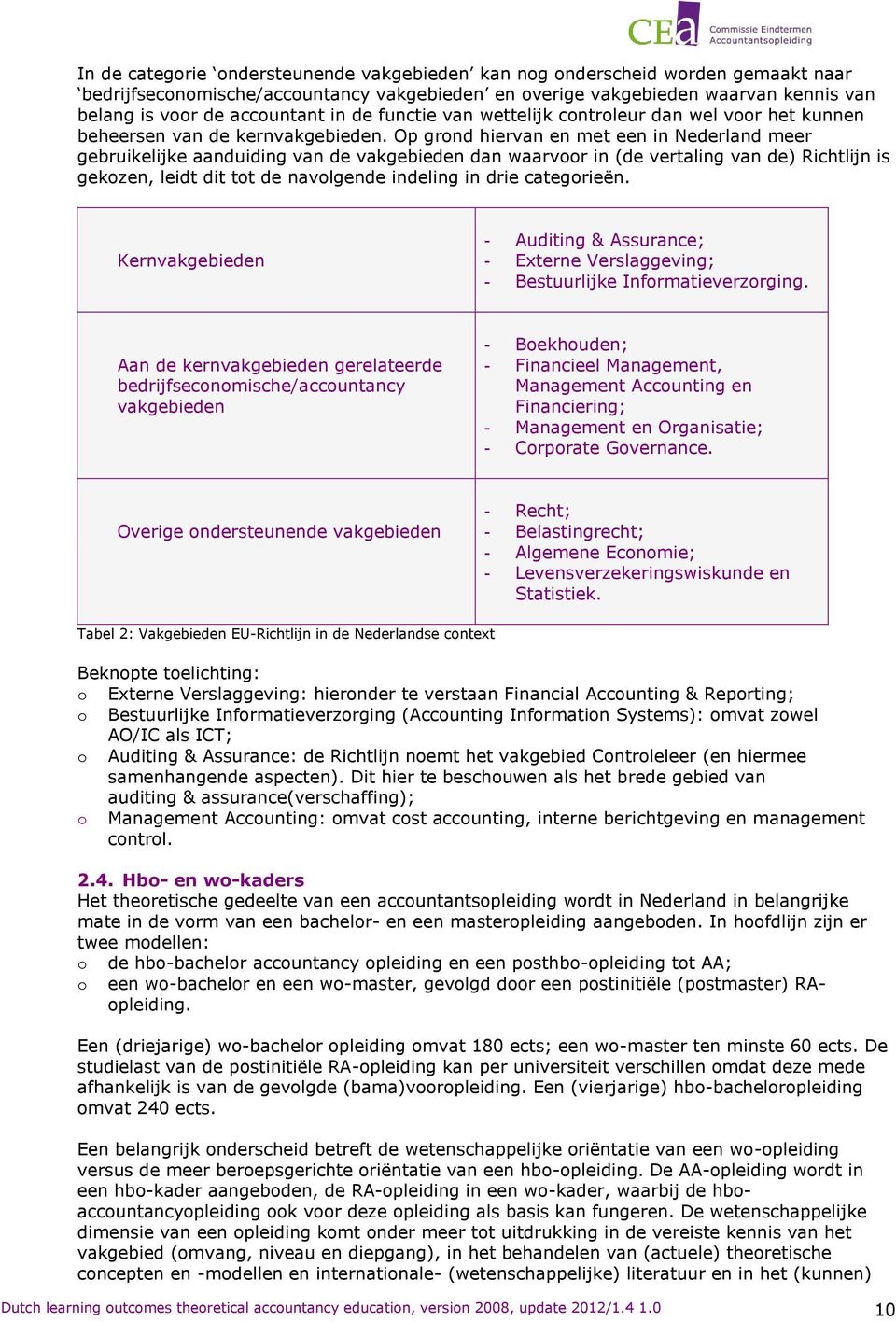
10 In de categorie ondersteunende vakgebieden kan nog onderscheid worden gemaakt naar bedrijfseconomische/accountancy vakgebieden en overige vakgebieden waarvan kennis van belang is voor de accountant in de functie van wettelijk controleur dan wel voor het kunnen beheersen van de kernvakgebieden. Op grond hiervan en met een in Nederland meer gebruikelijke aanduiding van de vakgebieden dan waarvoor in (de vertaling van de) Richtlijn is gekozen, leidt dit tot de navolgende indeling in drie categorieën. Kernvakgebieden - Auditing & Assurance; - Externe Verslaggeving; - Bestuurlijke Informatieverzorging. Aan de kernvakgebieden gerelateerde bedrijfseconomische/accountancy vakgebieden - Boekhouden; - Financieel Management, Management Accounting en Financiering; - Management en Organisatie; - Corporate Governance. Overige ondersteunende vakgebieden - Recht; - Belastingrecht; - Algemene Economie; - Levensverzekeringswiskunde en Statistiek. Tabel 2: Vakgebieden EU-Richtlijn in de Nederlandse context Beknopte toelichting: o Externe Verslaggeving: hieronder te verstaan Financial Accounting & Reporting; o Bestuurlijke Informatieverzorging (Accounting Information Systems): omvat zowel AO/IC als ICT; o Auditing & Assurance: de Richtlijn noemt het vakgebied Controleleer (en hiermee samenhangende aspecten). Dit hier te beschouwen als het brede gebied van auditing & assurance(verschaffing); o Management Accounting: omvat cost accounting, interne berichtgeving en management control Hbo- en wo-kaders Het theoretische gedeelte van een accountantsopleiding wordt in Nederland in belangrijke mate in de vorm van een bachelor- en een masteropleiding aangeboden. In hoofdlijn zijn er twee modellen: o o de hbo-bachelor accountancy opleiding en een posthbo-opleiding tot AA; een wo-bachelor en een wo-master, gevolgd door een postinitiële (postmaster) RAopleiding. Een (driejarige) wo-bachelor opleiding omvat 80 ects; een wo-master ten minste 60 ects. De studielast van de postinitiële RA-opleiding kan per universiteit verschillen omdat deze mede afhankelijk is van de gevolgde (bama)vooropleiding. Een (vierjarige) hbo-bacheloropleiding omvat 240 ects. Een belangrijk onderscheid betreft de wetenschappelijke oriëntatie van een wo-opleiding versus de meer beroepsgerichte oriëntatie van een hbo-opleiding. De AA-opleiding wordt in een hbo-kader aangeboden, de RA-opleiding in een wo-kader, waarbij de hboaccountancyopleiding ook voor deze opleiding als basis kan fungeren. De wetenschappelijke dimensie van een opleiding komt onder meer tot uitdrukking in de vereiste kennis van het vakgebied (omvang, niveau en diepgang), in het behandelen van (actuele) theoretische concepten en -modellen en internationale- (wetenschappelijke) literatuur en in het (kunnen) Dutch learning outcomes theoretical accountancy education, version 2008, update 202/.4.0 0
11 verrichten van wetenschappelijk onderzoek. Een hbo-opleiding is in beginsel meer toepassingsgericht en legt daarom een sterker accent op het ontwikkelen van praktische vaardigheden. Deze elementen kunnen, afhankelijk van het doel en de oriëntatie van de opleiding, deels afzonderlijk en deels geïntegreerd, in de vakgebieden aan (de eindtermen van) een curriculum worden toegevoegd ECTS credits per subject Based on the parameters, criteria and considerations described above, an allocation of ECTS credits per subject has been made (see Table ). This allocation reflects a minimum number of ECTS credits per category, thereby identifying the basic required per individual subject. The substantive elements of the core subjects must in any case be included in the initial programmes. The final to be achieved in these courses thus exceeds that of a bachelor s programme. Subjects to be included in curriculum Minimum number of ECTS credits Minimum total per category Core subjects 90 Auditing & Assurance External Reporting Accounting Information Systems Economic and accountancy subjects related to the core subjects 65 Bookkeeping *) Management Accounting Financial Management / Finance Management and Organization Corporate Governance *) Bookkeeping includes the bookkeeping aspects of Management Accounting, Finance and Financial Accounting, plus ICT aspects. Other supporting subjects 45 Law Tax Law General Economics Life Insurance Mathematics and Statistics Total Elective courses o the thesis or dissertation in university programmes, or the internship and graduation assignment in higher professional education (HBO); pm o academic component, esp. in university courses (incl. methodology and enrichment in quantitative methods and techniques); o enrichment in the subject areas of core courses; o enrichment from the professional profile; o specific focus of the educational institution. Table : Minimum number of ECTS credits per subject belonging to an accountancy programme Dutch learning outcomes theoretical accountancy education, version 2008, update 202/.4.0
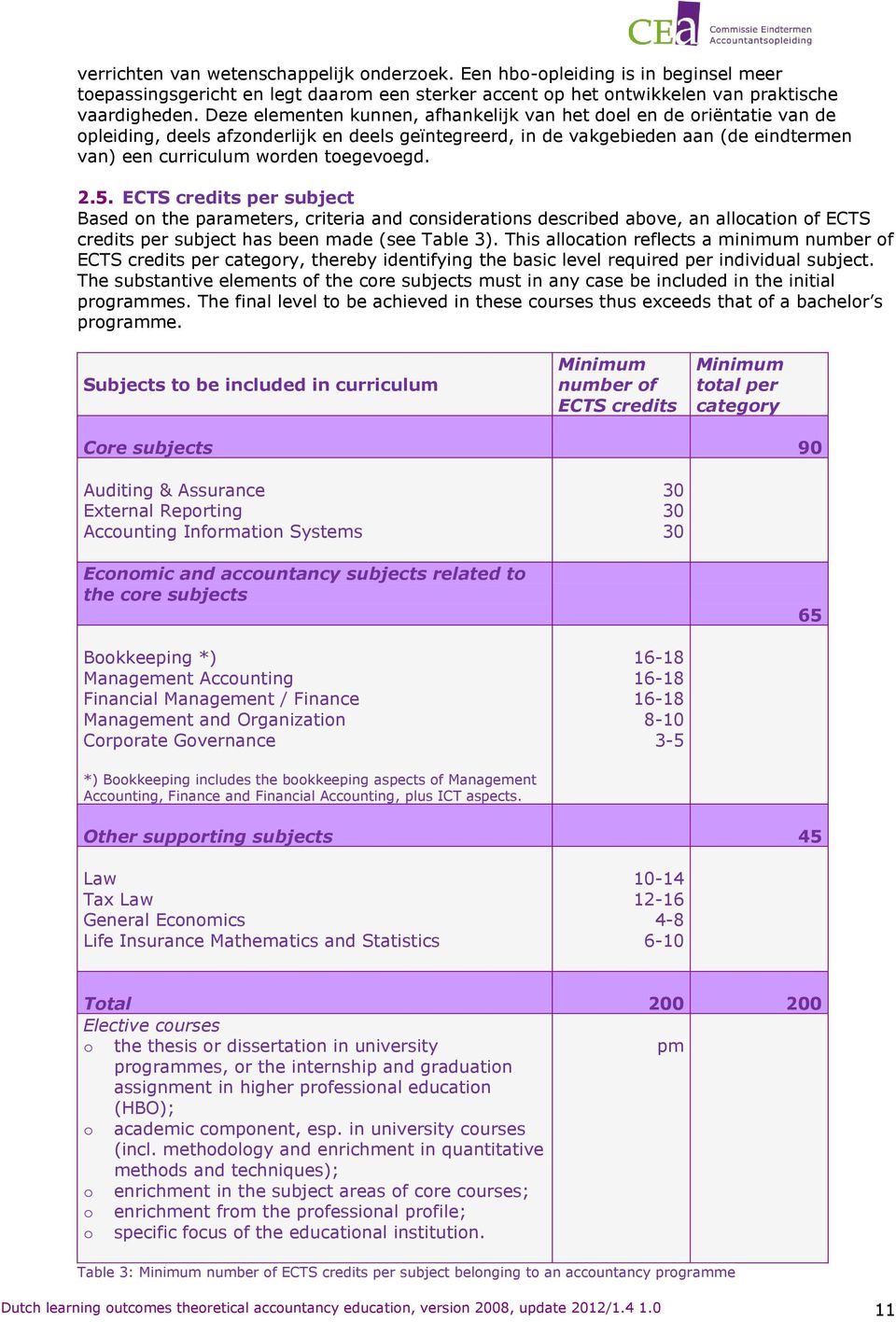
12 The number of ECTS credits allocated per category and subject give a representative view of the relative weight and significance of the core subjects of an accountancy study programme. As such, they are an indication of the minimum of attention that must be given to meet the learning outcomes for a specific subject. The number of ECTS credits shown by category constitutes a hard lower limit. The overall curriculum of an accountancy study programme must minimally contain the above number of ECTS credits per category. The number of credits assigned to the core subjects within the three categories likewise represents a hard lower limit. For the subjects belonging to the other two categories a margin of two ECTS credits is allowed in setting the lower limit for the economic and accountancy courses; a margin of four credits is allowed for the other supporting courses. As such, the minimum number of ECTS credits in a curriculum can differ somewhat for the individual courses within these categories. However, the total number of ECTS credits for the courses belonging to a specific category must meet the minimum that is fixed for that category. This distinction allows the various schools the possibility to put a heavier accent on one subject or another, so long as the exit requirements are met. As for the three core subjects, the minimum number of ECTS credits to be realized is 0 each. The category economic and accountancy subjects related to the core subjects require 65 ECTS credits; for other supporting subjects the minimum number is 45. The total number of ECTS credits for the subjects belonging to the curriculum of an accountancy study programme thus comes to a minimum of 200. These credits are incorporated into an accountancy study programme, which may consist of a bachelor s, a post-bachelor s, a master s and a postmaster s phase. The elective courses may be allocated within a university- programme or a higher professional education programme to the separate phases of an accountancy programme Educational Under the Directive, natural persons may only perform statutory audits of annual accounts if they have followed, after attainment of the for enrolment in a university or equivalent, both a theoretical and a practical programme and have passed a professional competence examination organized or recognized by the Member State, which corresponds in terms of with that of a completed university or equivalent programme. As to the study programme to become an accounting consultant (AA), with due regard to the Directive and the professional profile established by NOvAA (Nederlandse Orde van Accountants-Administratieconsulenten), the required educational must be that of a completed bachelor s programme in economics at a professional school of higher education, supplemented by a post-graduate programme directed at future practical employment in the field. As to the study programme to become a registered accountant (RA), with due regard to the Directive and based on the draft professional profile 6 established by NIVRA (Nederlands Instituut van Registeraccountants), the required educational must be that of a completed university master s programme, which may be supplemented by a post-master s programme directed at future practical employment in the field. 6 The NIVRA draft regulation of September 2006 regarding the professional profile of the registered accountant is still subject to discussion. It is expected to be submitted for adoption at the NIVRA membership meeting in the spring of In that context NIVRA intends to include the requirement of an academic master as part of the professional profile. For purposes of the established exit requirements, CEA therefore makes a reservation regarding the adoption of the professional profile by the NIVRA membership meeting. Dutch learning outcomes theoretical accountancy education, version 2008, update 202/.4.0 2
13 . Description of learning outcomes. Introduction The description of the core subjects links up with recent memoranda that have been written by professors in these subjects on behalf of the accountancy study programme. These memoranda constitute a state-of-the-art description by experts in the field. For that reason these memoranda have been linked to, without literally copying them. Adjustments have been introduced, for example in connection with recent developments in the legislative and regulatory setting, plus to take into account the specific academic or enriching elements in the memoranda that may be relevant within a university setting but less so within a programme at professional education (HBO). However, the approach taken in the memoranda has been kept intact as much as possible in order to ensure optimum legibility of the individual elements. Legibility and support have thus been opted for, rather than uniformity of structure. The description of the other subjects links up with the current examination programmes of the former examination bureaus. Adjustments have been made to these programmes, both in connection with the aspects mentioned above, and in the light of current developments in the field of ICT and specifically with regard to the SME-related learning outcomes of the examination programme for accountancy consultants, as separately covered in chapter 4. In describing the various subjects, two separate phases have been considered: bachelormaster and post-initial. The description of the learning outcomes recognizes these two phases. Further specialization does not need to be reflected in these phases but may be included in the post-experiential phase, following completion of the accountancy study programme. There is no prescribed literature list. This is the responsibility of the schools and universities. Relevant laws and regulations obviously have a place in the selected literature. Each subject has a specific. These are explained in section.. This is followed in.4 with a description per subject for both the AA and RA study programmes. When fleshing this out, consideration can be given to such aspects as the university or professional school environment, or a complex company structure versus an SME environment. In order to separately highlight specific aspects of the SME component, detailed descriptions of Strategic Management and Tax Consultancy for SME are included in chapter 4. These elements are mandatory for the AA programme..2 Use of learning outcomes by the educational institutions To ensure that the programmes reflect today s situation, the learning outcomes must always be based on the most recent legislative and regulatory setting and recent developments in the accountancy profession and relevant subjects. Testing of students on specific learning outcomes will be based on the most recent laws and regulations. Where learning outcomes refer to specific laws or regulations, the most recent relevant version of such laws and regulations must always be studied in preparation. Furthermore, relevant developments in the various subjects, such as the results of academic and other research, must be incorporated in the study programmes. To link up with the EU directive, a description of the learning outcomes is by subject. An integrated approach to these subjects and to their study is essential. The study programmes must therefore include specific integration moments, in particular for the learning outcomes of the core subjects. Dutch learning outcomes theoretical accountancy education, version 2008, update 202/.4.0
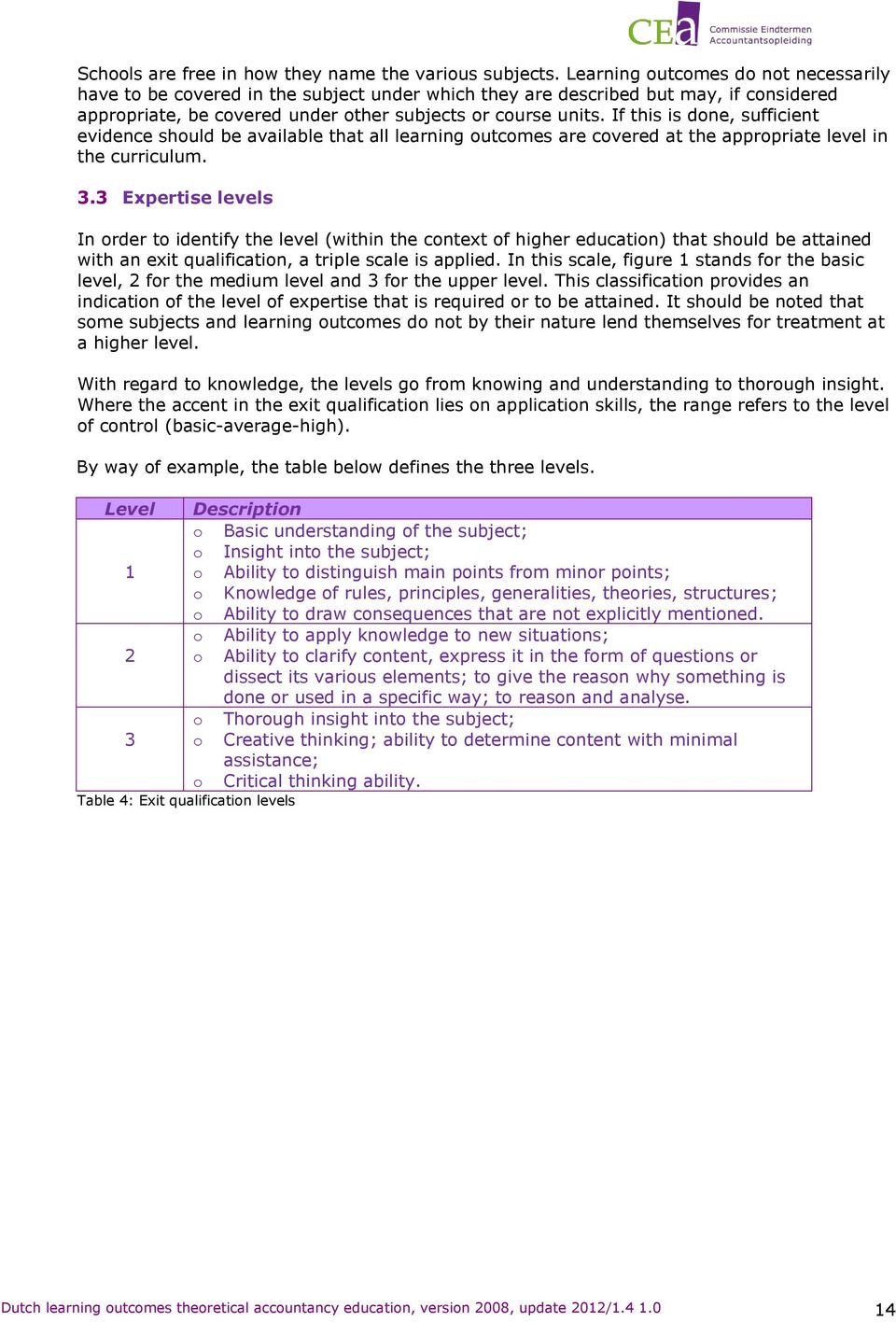
14 Schools are free in how they name the various subjects. Learning outcomes do not necessarily have to be covered in the subject under which they are described but may, if considered appropriate, be covered under other subjects or course units. If this is done, sufficient evidence should be available that all learning outcomes are covered at the appropriate in the curriculum.. Expertise s In order to identify the (within the context of higher education) that should be attained with an exit qualification, a triple scale is applied. In this scale, figure stands for the basic, 2 for the medium and for the upper. This classification provides an indication of the of expertise that is required or to be attained. It should be noted that some subjects and learning outcomes do not by their nature lend themselves for treatment at a higher. With regard to knowledge, the s go from knowing and understanding to thorough insight. Where the accent in the exit qualification lies on application skills, the range refers to the of control (basic-average-high). By way of example, the table below defines the three s. Level Description o Basic understanding of the subject; o Insight into the subject; o Ability to distinguish main points from minor points; o Knowledge of rules, principles, generalities, theories, structures; o Ability to draw consequences that are not explicitly mentioned. o Ability to apply knowledge to new situations; 2 o Ability to clarify content, express it in the form of questions or dissect its various elements; to give the reason why something is done or used in a specific way; to reason and analyse. o Thorough insight into the subject; o Creative thinking; ability to determine content with minimal assistance; o Critical thinking ability. Table 4: Exit qualification s Dutch learning outcomes theoretical accountancy education, version 2008, update 202/.4.0 4
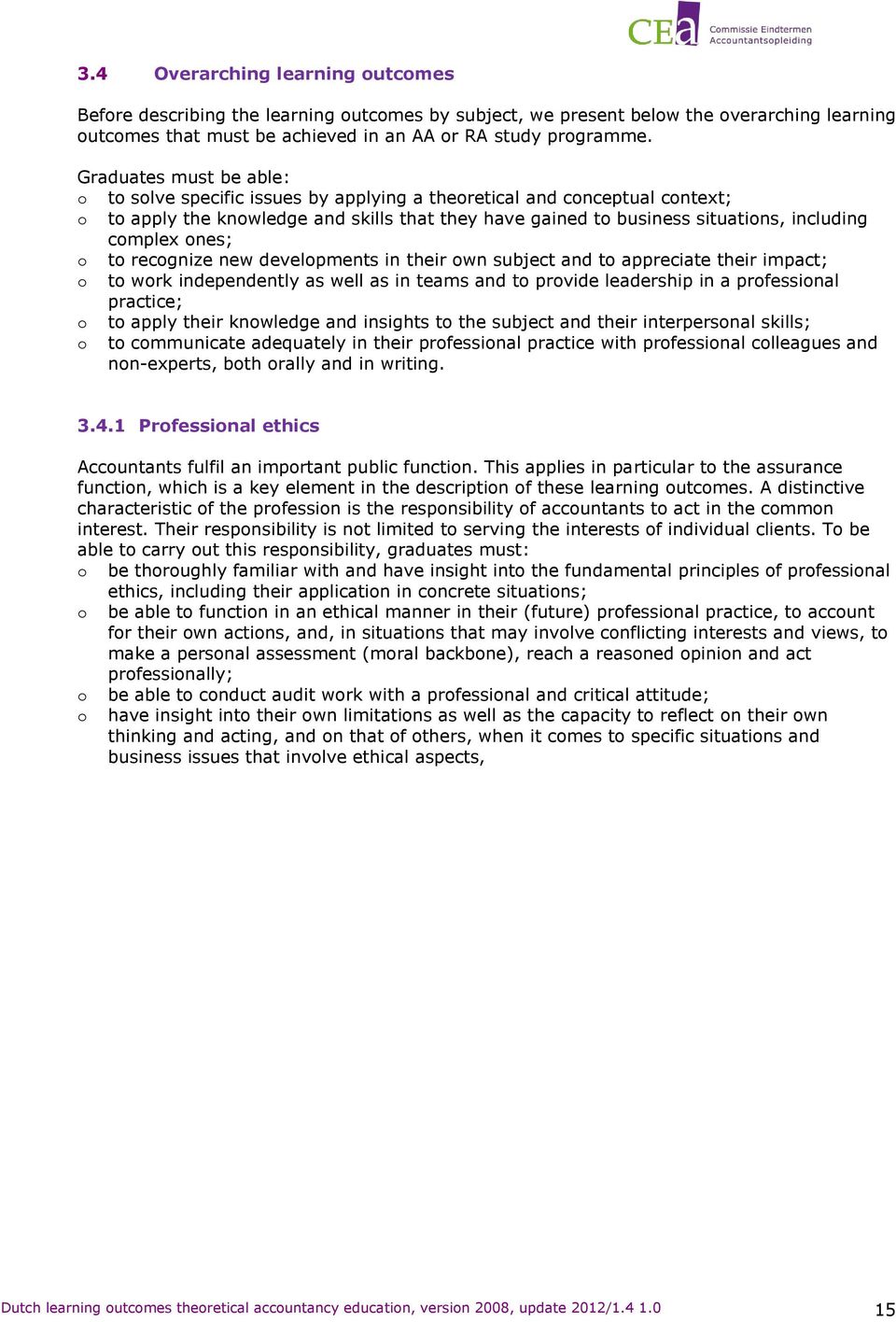
15 .4 Overarching learning outcomes Before describing the learning outcomes by subject, we present below the overarching learning outcomes that must be achieved in an AA or RA study programme. Graduates must be able: o to solve specific issues by applying a theoretical and conceptual context; o to apply the knowledge and skills that they have gained to business situations, including complex ones; o to recognize new developments in their own subject and to appreciate their impact; o to work independently as well as in teams and to provide leadership in a professional practice; o to apply their knowledge and insights to the subject and their interpersonal skills; o to communicate adequately in their professional practice with professional colleagues and non-experts, both orally and in writing..4. Professional ethics Accountants fulfil an important public function. This applies in particular to the assurance function, which is a key element in the description of these learning outcomes. A distinctive characteristic of the profession is the responsibility of accountants to act in the common interest. Their responsibility is not limited to serving the interests of individual clients. To be able to carry out this responsibility, graduates must: o be thoroughly familiar with and have insight into the fundamental principles of professional ethics, including their application in concrete situations; o be able to function in an ethical manner in their (future) professional practice, to account for their own actions, and, in situations that may involve conflicting interests and views, to make a personal assessment (moral backbone), reach a reasoned opinion and act professionally; o o be able to conduct audit work with a professional and critical attitude; have insight into their own limitations as well as the capacity to reflect on their own thinking and acting, and on that of others, when it comes to specific situations and business issues that involve ethical aspects, Dutch learning outcomes theoretical accountancy education, version 2008, update 202/.4.0 5
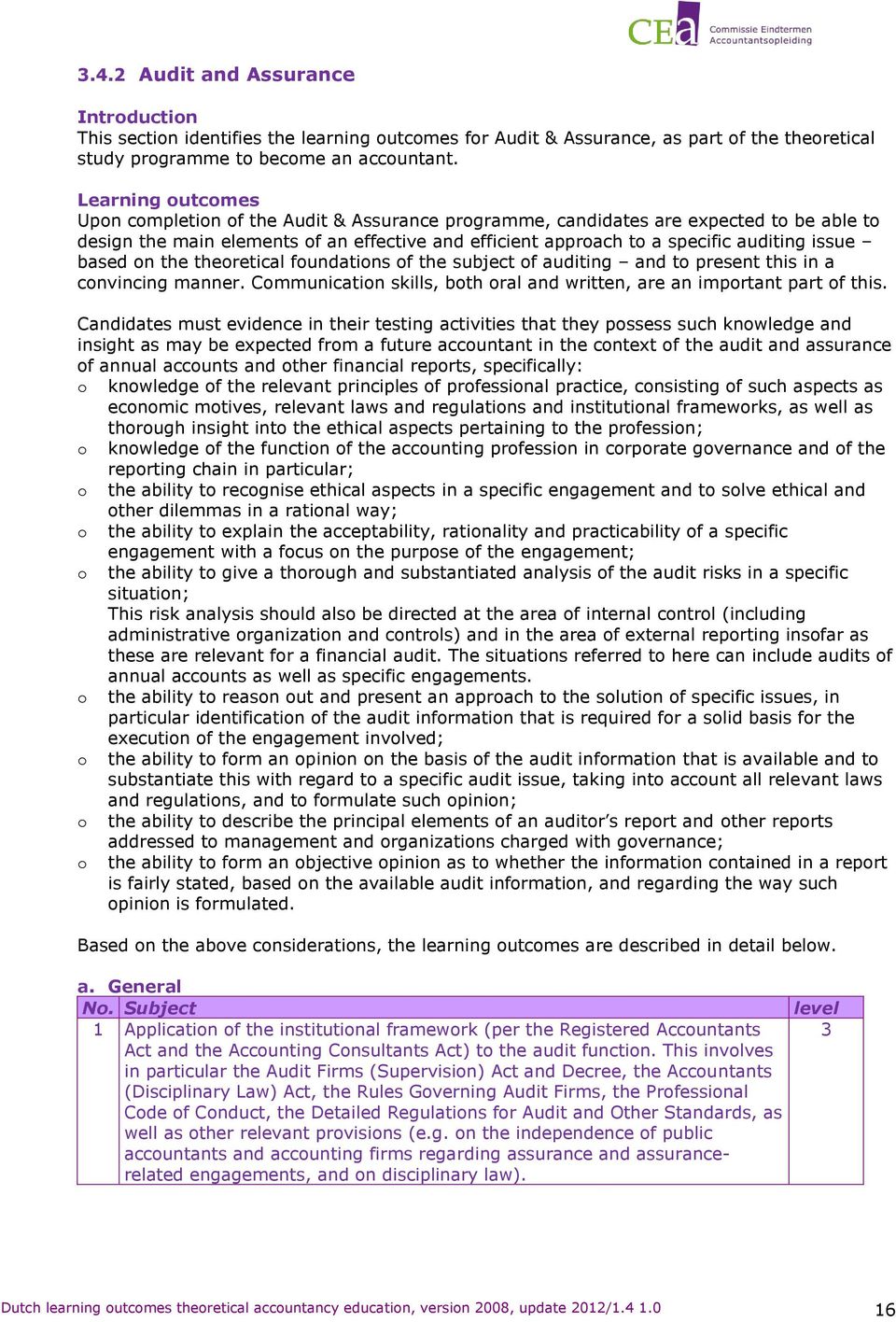
16 .4.2 Audit and Assurance Introduction This section identifies the learning outcomes for Audit & Assurance, as part of the theoretical study programme to become an accountant. Learning outcomes Upon completion of the Audit & Assurance programme, candidates are expected to be able to design the main elements of an effective and efficient approach to a specific auditing issue based on the theoretical foundations of the subject of auditing and to present this in a convincing manner. Communication skills, both oral and written, are an important part of this. Candidates must evidence in their testing activities that they possess such knowledge and insight as may be expected from a future accountant in the context of the audit and assurance of annual accounts and other financial reports, specifically: o knowledge of the relevant principles of professional practice, consisting of such aspects as economic motives, relevant laws and regulations and institutional frameworks, as well as thorough insight into the ethical aspects pertaining to the profession; o knowledge of the function of the accounting profession in corporate governance and of the reporting chain in particular; o the ability to recognise ethical aspects in a specific engagement and to solve ethical and other dilemmas in a rational way; o the ability to explain the acceptability, rationality and practicability of a specific engagement with a focus on the purpose of the engagement; o the ability to give a thorough and substantiated analysis of the audit risks in a specific situation; This risk analysis should also be directed at the area of internal control (including administrative organization and controls) and in the area of external reporting insofar as these are relevant for a financial audit. The situations referred to here can include audits of annual accounts as well as specific engagements. o the ability to reason out and present an approach to the solution of specific issues, in particular identification of the audit information that is required for a solid basis for the execution of the engagement involved; o the ability to form an opinion on the basis of the audit information that is available and to substantiate this with regard to a specific audit issue, taking into account all relevant laws and regulations, and to formulate such opinion; o the ability to describe the principal elements of an auditor s report and other reports addressed to management and organizations charged with governance; o the ability to form an objective opinion as to whether the information contained in a report is fairly stated, based on the available audit information, and regarding the way such opinion is formulated. Based on the above considerations, the learning outcomes are described in detail below. a. General Application of the institutional framework (per the Registered Accountants Act and the Accounting Consultants Act) to the audit function. This involves in particular the Audit Firms (Supervision) Act and Decree, the Accountants (Disciplinary Law) Act, the Rules Governing Audit Firms, the Professional Code of Conduct, the Detailed Regulations for Audit and Other Standards, as well as other relevant provisions (e.g. on the independence of public accountants and accounting firms regarding assurance and assurancerelated engagements, and on disciplinary law). Dutch learning outcomes theoretical accountancy education, version 2008, update 202/.4.0 6
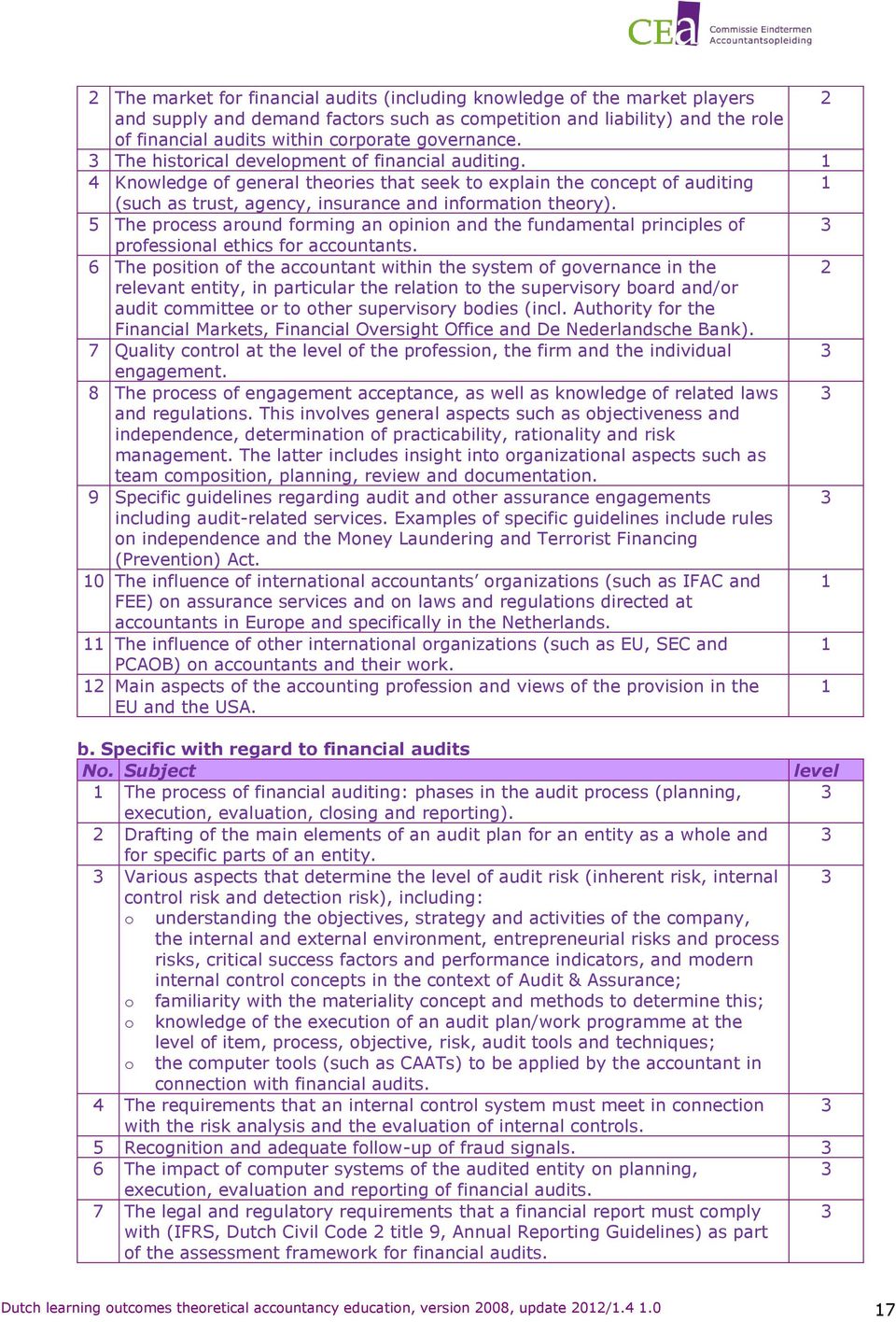
17 2 The market for financial audits (including knowledge of the market players 2 and supply and demand factors such as competition and liability) and the role of financial audits within corporate governance. The historical development of financial auditing. 4 Knowledge of general theories that seek to explain the concept of auditing (such as trust, agency, insurance and information theory). 5 The process around forming an opinion and the fundamental principles of professional ethics for accountants. 6 The position of the accountant within the system of governance in the 2 relevant entity, in particular the relation to the supervisory board and/or audit committee or to other supervisory bodies (incl. Authority for the Financial Markets, Financial Oversight Office and De Nederlandsche Bank). 7 Quality control at the of the profession, the firm and the individual engagement. 8 The process of engagement acceptance, as well as knowledge of related laws and regulations. This involves general aspects such as objectiveness and independence, determination of practicability, rationality and risk management. The latter includes insight into organizational aspects such as team composition, planning, review and documentation. 9 Specific guidelines regarding audit and other assurance engagements including audit-related services. Examples of specific guidelines include rules on independence and the Money Laundering and Terrorist Financing (Prevention) Act. 0 The influence of international accountants organizations (such as IFAC and FEE) on assurance services and on laws and regulations directed at accountants in Europe and specifically in the Netherlands. The influence of other international organizations (such as EU, SEC and PCAOB) on accountants and their work. 2 Main aspects of the accounting profession and views of the provision in the EU and the USA. b. Specific with regard to financial audits The process of financial auditing: phases in the audit process (planning, execution, evaluation, closing and reporting). 2 Drafting of the main elements of an audit plan for an entity as a whole and for specific parts of an entity. Various aspects that determine the of audit risk (inherent risk, internal control risk and detection risk), including: o understanding the objectives, strategy and activities of the company, the internal and external environment, entrepreneurial risks and process risks, critical success factors and performance indicators, and modern internal control concepts in the context of Audit & Assurance; o familiarity with the materiality concept and methods to determine this; o knowledge of the execution of an audit plan/work programme at the of item, process, objective, risk, audit tools and techniques; o the computer tools (such as CAATs) to be applied by the accountant in connection with financial audits. 4 The requirements that an internal control system must meet in connection with the risk analysis and the evaluation of internal controls. 5 Recognition and adequate follow-up of fraud signals. 6 The impact of computer systems of the audited entity on planning, execution, evaluation and reporting of financial audits. 7 The legal and regulatory requirements that a financial report must comply with (IFRS, Dutch Civil Code 2 title 9, Annual Reporting Guidelines) as part of the assessment framework for financial audits. Dutch learning outcomes theoretical accountancy education, version 2008, update 202/.4.0 7
18 8 Financial audit methods, tools and techniques; nature, scope (random observations including samples) and timing of documentation to be obtained, both at individual item and process. 9 Use of the work of other auditors (also acting as group auditor) and other experts. 0 Closing of the audit, including the process of forming an opinion, evaluation of findings and decision-making related to the auditor s report to be issued. The responsibility of the auditor for the annual report requires attention. Special subjects that need to be addressed in the closing phase include subsequent events, off-balance sheet commitments, reporting and audit issues pertaining to related party transactions, and going concern issues. Reporting of findings: auditor s reports, management letters and other forms of reporting (including electronic reporting such as XBRL), with knowledge and insight regarding the scope of responsibility of the auditor in such matters. c. Other Assurance Services The need for assurance services in a general sense (reliability and relevance of information, corporate governance, stakeholder identification, sustainability, etc.). 2 The assurance framework (IFAC) and different objects of assurance services (data, processes/systems and conduct). The assurance process in a broad sense (planning, execution, evaluation and reporting) as well as understanding of specific elements ( of certainty, standards and criteria). 4 Various assurance services such as evaluation of financial information, 2 assurance regarding non-financial information, compliance reviews, examinations on behalf of government (lawfulness aspect), other special investigations aimed at providing assurance (including audit engagements subject to the Detailed Regulations for Audit and Other Standards 800 series). 5 Preparation of main features and details of plan of execution of such 2 assurance services. 6 Evaluation of the results of the examination and their impact on the 2 opinion to be issued. 7 Reporting on results of other assurance services: impact of the nature of the 2 engagement on the reporting format, types of reporting, etc. 8 Communication by the auditor/assurance provider with stakeholders. 2 9 International developments in the field of assurance services (including continuous assurance). d. Other Services Compilation engagements and engagements to perform agreed specific activities regarding financial information (esp. the differences between audit and review engagements): objective, underlying principles, engagement terms, planning, documentation, activities to be performed and reporting. 2 Performance of agreed specific activities regarding non-financial 2 information. Transaction-related advisory services. 2 Dutch learning outcomes theoretical accountancy education, version 2008, update 202/.4.0 8
19 .4. External reporting Introduction This section lists the learning outcomes for External Reporting, as part of the theoretical study programme leading to certification as an accountant. External reporting is defined as the supply of information of a mainly financial and economic nature, in a more or less standardized form, by the management of an organization to stakeholders and other interested parties. Stakeholders and interested parties include in particular the shareholders, loan-providing banks, other suppliers of long-term credit, employees, suppliers, customers and the general public. A specific feature of external reporting is that it involves a certain measure of public disclosure. External reporting differs in that sense from management reporting (reporting that is principally aimed at supply of information to the management of an organization) and of the supply of information to tax authorities to enable them to establish tax assessment amounts. Overlap with other subjects External reporting can be regarded in a general sense as a discipline related to business economics, but one that also involves legal aspects. The legal aspects relate in particular to accounting law and, in a more general sense, to company law. Accounting law involves mainly the legal regulations regarding the contents of the annual accounts and the annual report. Company law includes related subjects such as the preparation, adoption and approval of the annual accounts, the jurisdiction related to annual accounts, the liability for falsified annual accounts, and capital maintenance law. External reporting obviously overlaps in various respects with other subjects that fall under business economics. Here too the boundaries are not always sharply drawn, so that various issues involving the provision of information can fall under different subjects. We have already mentioned internal reporting above. Internal reporting can be regarded from different angles: o the administrative and bookkeeping angle: the subject of Bookkeeping; o the organization of the internal provision of information, including the reliability of information and the adequacy of administrative procedures: the subject of Accounting Information Systems and Administrative Organization; o the use of internal information for planning, control, product costing and decision-making: the subjects of Management Accounting, Cost Issues, Internal Reporting or Internal Provision of Information. The data that originate from the internal information system are obviously also relevant for information to be reported externally. For that reason the subject of Bookkeeping falls under External Reporting. Sometimes issues are explicitly relevant to both internal and external reporting. An example is the determination of the cost of stocks: this is relevant for pricing, margin calculation and product range decisions, as well for the valuation on the balance sheet. Another subject that is strongly related to external reporting is auditing. An audit is especially aimed at establishing whether external reports, in particular annual accounts, are fairly stated and thus sufficiently reliable for both internal and external stakeholders and other interested parties. In that sense, auditing relies on external reporting. However, it also addresses other issues, such as the scope of audit work and methods applied, the way conclusions are drawn, the methods of reporting to the outside world, and the requirements pertaining to the professional conduct of auditors. Lastly there is the subject of Finance and Investment. Issues that directly overlap with external reporting and that can be linked to both subjects especially include: o assessments and decisions by current and potential shareholders and lenders on the basis of information in annual accounts; this may involve ratio analysis and other financial analysis issues and the consequences of annual accounts information for share prices; Dutch learning outcomes theoretical accountancy education, version 2008, update 202/.4.0 9
20 o o cash flow calculations, such as for the purpose of setting company values in order to determine the need of impairments, also in relation to the valuation of companies or business units in the context of acquisitions and mergers and for the determination of the value of goodwill; determination of the fair value of assets; this may include such applications as the Black- Scholes model for calculating the fair value of options and valuation models to determine the fair value of financial instruments. Auditors are not financial analysts or value appraisers, but they nonetheless face these issues in the context of their professional practice. For that reason a good understanding is required of the aspects that play a role in this. This is addressed in further detail in the section on financial analysis. External reporting in further detail Table a presents a classification by reporting object based on the following two criteria: o primarily financial or non-financial; o periodic or non-periodic. Primarily financial Periodic o annual accounts o quarterly and semi-annual figures o financial press releases Non-periodic o prospectus o incidental equity statements Table a: External reporting by object Primarily non-financial o annual report (report by the Executive Board) o other information o environmental report o social report o corporate responsibility report o other external information o financial/economic brochures o press releases It should be noted that external reporting, as its definition indicates, is limited to information that is primarily financial and/or economic and follows a more or less standardized format. Not all reports mentioned in Table a meet this criterion. For example, an environmental report that is mainly technical (emission values, etc.) would not fall under external reporting as defined here (but instead under the much broader corporate communications). However, an environmental report that contains financial data and economic information (environmental costs or related investment plans) is a form of financial-economic external reporting. Again, there is no sharp boundary. Dutch learning outcomes theoretical accountancy education, version 2008, update 202/
21 Another classification is aimed at the purpose and function of the issues that external reporting deals with. Table b contains a listing that is based on two criteria: o primarily aimed (or not) at the content of the object; o involving (or not) a normative character. It is recognized that this classification is somewhat arbitrary and that various components overlap. Primarily aimed at content Normative character o general principles o laws and regulations regarding content; o international harmonization; o valuation and determination of periodic results Descriptive and o empirical research explanatory o annual accounts policy Not primarily aimed at content o laws and regulations and jurisprudence regarding annual accounts, environmental report, etc. o financial analysis. o o theory development history Table b. External reporting divided into purpose and function The most important object of External Reporting is the annual accounts. The most important quadrant in Table b is that at the upper left. After all, external reporting in the context of the accountancy study programme deals especially with content as viewed from a normative viewpoint. That does not imply that the other objects and quadrants are unimportant. However, they will get less attention. International developments The subject of External Reporting is traditionally known in the international context as Financial Accounting or Financial Reporting. The Dutch and international contents are roughly parallel. Internationally (especially in the United States) we see the following modules: o Accounting: a broad basic module that includes internal reporting, management accounting and bookkeeping; o Financial Accounting: a basic module for financial accounting, aimed at general aspects of the balance sheet, the profit and loss account and the cash flow statement; o Intermediate Financial Accounting: a follow-up module in financial accounting, aimed at specific issues related to items in the balance sheet and profit and loss account, and miscellaneous subjects including pensions, leasing, taxation and inflation accounting; o Advanced Financial Accounting: specialization module that especially covers the following subjects: consolidation, acquisition and mergers, foreign currencies, financial instruments and special organizations (partnerships, government organizations, health care organizations, colleges and universities); o International Accounting: aimed at external reporting in an international perspective; o Financial Accounting Theory: overview of theories related to the field; o Financial Analysis: discussion of issues in the field of financial analysis. Important elements covered in the modules under 2 through 5 are the views regarding regulations (Dutch and/or international). In the international context, especially in Anglo- Saxon countries, specific subjects are dealt with first, with the theory being covered in a later phase during the programme. An important development in the area of external reporting is that international harmonization is leading to the subject, especially the regulatory aspects, is becoming increasingly international. In this regard it is important to note that companies listed on European stock exchanges are required since 2005 to prepare their consolidated annual accounts in accordance with International Financial Reporting Standards (IFRS), as established by the Dutch learning outcomes theoretical accountancy education, version 2008, update 202/.4.0 2
22 International Accounting Standards Board (IASB). Furthermore, the differences from the rules in the United States (US GAAP) are steadily getting smaller. The IFRS standards also have significant impact on non-listed companies, either because they voluntarily choose to apply IFRS, or because IFRS are impacting national legislation. For the curriculum this means that international accounting as mentioned above can hardly be regarded anymore as a separate module. This development has been considered in the learning outcomes described below. Another development is that of the demand aspect. The demands of shareholders, financial analysts and rating agencies regarding external reporting are steadily growing. These demands can go further than the legislative and regulatory requirements. The debate regarding the need for transparency and adequate corporate governance contributes to this. Learning outcomes Successful completion of the accountancy curriculum leads to the title of registered accountant (RA) or accounting consultant (AA), with particular focus on the profession of public accountant. In addition, the positions of internal auditor and government auditor are addressed. The most important task of the public accountant is to conduct statutory audits of annual accounts. That requires a thorough understanding of external reporting requirements and issues. The following modules must be viewed in that light, and it is essential that the auditor has a full understanding of these. External reporting principles The accountant must have a thorough understanding of the principles related to external reporting as contained in what are referred to as conceptual frameworks (or, in Netherlands, the Framework for the Preparation and Presentation of Financial Statements). These cover subjects such as the objectives of financial reporting, the quality features, the meaning of concepts such as assets, liabilities, revenues and expenses, and generally accepted accounting principles. In addition, subjects that are not directly linked to the conceptual framework are important, such as the relationship between income and equity (which comes first?), the accounting concept of profit versus the economic concept of profit, the concept of fair value accounting, and more. A thorough knowledge of the principles is especially necessary to prevent the auditor from functioning strictly as someone who establishes whether specific rules are complied with. On the contrary, the auditor must in the first place determine, based on professional judgement, whether the annual accounts are fairly stated and thus meet the legal requirement that they present a true and fair view. Strict compliance with the rules is not by definition sufficient for this purpose, and it may even be necessary to deviate from strict rules in order to meet the requirement of proper insight. The principles of external reporting are decisive in that regard. A good auditor must know when his professional judgement makes it necessary to deviate from the rules or to set additional requirements. It is also important that the auditor has sufficient insight into the amount of disclosure (explanations in the notes) that is needed to meet the qualitative characteristic of relevant reporting. The auditor must furthermore be aware of the annual accounts policy of a company s management and of the related economic consequences. The above Framework is not necessarily the starting point for financial reporting only but may also serve as the broad basis for external reporting. For example, the rules for sustainability reporting of the Global Reporting Initiative (GRI) are based on this Framework. Learning outcomes The principles of external reporting. 2 The principles of Dutch laws and regulations with regard to reporting and of Dutch learning outcomes theoretical accountancy education, version 2008, update 202/
23 IFRS. The institutional context of reporting in the Netherlands and of IFRS. 4 The professional judgement of the accountant in applying reporting standards. 5 Application of generally accepted accounting principles, including the concept of fair value accounting. 6 Main features of the annual accounts policy of corporate management and 2 of the economic consequences of annual accounts policy. 7 The main features of the rules for sustainability reporting. Applications of external reporting When regard to financial reporting applications, the various issues can be subdivided as follows: o Based on individual line items in the balance sheet and profit and loss account: intangible fixed assets, tangible fixed assets, financial fixed assets, stocks, receivables, marketable securities, cash, shareholders equity, provisions, payables, revenues, operating results, extraordinary income and expenses. o Based on the nature and purpose of the annual accounts: inclusion in the balance sheet of assets and liabilities ( recognition and derecognition ), valuation and determination of periodic results, impairment, consolidation, presentation of the balance sheet, profit and loss account and cash flow statement and related disclosures. o Based on the processing of events and transactions in the annual accounts: inflation, currency fluctuations, investments and disposals, acquisitions and mergers, start-up of joint ventures, reorganizations, new contracts, payment of taxes, implementation or amendment of pension schemes, acquisition of loans, emission of shares, purchase of treasury shares, derivatives trading, leasing, factoring, government subsidies, insolvency. o Based on the legal nature of the reporting entity: public limited company (NV), private limited company (BV), cooperative association, mutual benefit association, foundation, association, limited partnership, general partnership, professional partnership, sole proprietorship; listed or non-listed. o Based on the economic nature of the reporting entity: production companies, builders, trading companies, publishers, service companies, banks, insurance companies, investment firms, agricultural firms, fundraising entities, hospitals, housing associations, municipal and provincial governments, national government. o Based on the country of incorporation of the reporting entity: reporting requirements and practices in different countries, reporting problems experienced by multinationals, international harmonization. o Based on the reporting object: annual accounts (or financial statements) and annual report, interim reports, environmental reports, etc. (see Table a). o Based on taxation principles ( samenvalregeling, coincidence rule). In the context of annual audits, an auditor must have knowledge and insight from various perspectives and at two s: o Dutch laws and regulations; o International Financial Reporting Standards of the IASB. In addition the auditor must be familiar with the International Financial Reporting Standards for Small and Medium-Sized Enterprises (IFRS-SME) and how these are applied. For listed companies it is also necessary to be familiar with specific stock market regulations regarding publication of financial information and of how to deal with price-sensitive information. This does not mean that accountants must have all rules at their fingertips, but they must know of the existence and main contents of the regulations, and they must understand and be able to apply the regulations in specific situations. Dutch learning outcomes theoretical accountancy education, version 2008, update 202/.4.0 2
24 Learning outcomes Level Reflecting events and transactions correctly in the balance sheet, profit and loss account and cash flow statement, and providing adequate disclosure on these, taking into account relevant Dutch laws and regulations and IFRS. 2 Knowledge of IFRS-SME, their potential application and the differences from 2 full-fledged IFRS. The formal/legal requirements that apply to the preparation and publication of financial information for Dutch public and private limited companies. 4 Several distinctive aspects of the impact of the legal nature of other reporting entities (general partnership, limited partnership, sole proprietorship, cooperative association and foundation) on the annual accounts. 5 Several distinctive aspects of the impact of the economic nature of the reporting entity on the annual accounts of financial institutions, not-forprofit institutions and other special organizations. 6 Several distinctive aspects of the impact of the country of incorporation of the reporting entity on the annual accounts. 7 Main features of the content, role and purpose of the annual report and of interim reports. 8 Several distinctive features of environmental reports. Financial analysis The auditor issues his report on behalf of the general public. This report, in which the auditor expresses his opinion as to whether the balance sheet and profit and loss account, in combination with the related notes, are fairly stated, enables the general public to form a rational opinion. This opinion can be the basis for different decisions, such as buying or selling shares or providing a loan. It is therefore important that the auditor be familiar with the way professional users in this case financial analysts come to their decisions. That requires a general knowledge of financial analysis. Such knowledge does not need to be in depth since the auditor is not a financial analyst. The knowledge will especially relate to principles and general concepts and not to techniques. Learning outcomes Level The main features of the principles and general concepts of financial analysis. 2 Applying a few simple basic techniques employed in financial analysis. 2 The way professional users in social and economic life form opinions on annual accounts. Dutch learning outcomes theoretical accountancy education, version 2008, update 202/
25 .4.4 Accounting Information Systems Introduction This section describes the learning outcomes for Accounting Information Systems (AIS), as part of the theoretical programme leading to certification as an accountant. Consultation among Dutch professors has led to this subject being referred to as Bestuurlijke Informatieverzorging (BIV) in the Netherlands, while it is called Accounting Information Systems internationally. These terms may be supplemented by names that differ by educational institution. As such, course names such as Organization of Information Provision (Organisatie van de Informatieverzorging, OIV), Internal Control (Interne Beheersing, IB or IC), Administrative Organization (Administratie Organisatie, AO) or combinations of these may only be used in combination with the term Bestuurlijke Informatieverzorging (Accounting Information Systems). The description of the learning outcomes for BIV/AIS assumes ten knowledge domains that cover the total subject, and a fixed structure applies that describes each of these domains. The domains are as follows (with the Dutch terms in brackets to ensure recognition within the Netherlands): K: People (Mensen) K2: Structures (Structuren) K: Processes (Processen) K4: Efficiency and Effectiveness of Operations (Efficiëntie en effectiviteit van de bedrijfsvoering) K5: Enterprise Risk Management (Risicomanagement) K6: Information and Communication Technology (Informatie- en communicatietechnologie) K7: Relevance of Information (Relevantie van informatie) K8: Reliability of Information (Betrouwbaarheid van informatie) K9: Safeguarding of Assets (Bewaking van de activa van organisaties) K0: Compliance with Applicable Laws and Regulations (Naleving van weten regelgeving) The ten knowledge domains link up with those that are described in the COSO publications on Internal Control en Enterprise Risk Management. The AIS subject is centred on the aspect of management information. The ten knowledge domains are thus considered from the viewpoint of accounting information systems, but may also come up in other subjects. This can be illustrated in the following table: K K2 K K4 K5 K6 K7 K8 K9 K0 AIS MA IM Other The above knowledge domains therefore also apply to other subjects. Each subject examines the various knowledge domains from a specific angle. In AIS this is done from the viewpoint of accounting information systems and their role in the control of organizations. As a result the accents on the knowledge domains when defining curricula will differ depending on whether the focus lies on accounting information systems, management accounting, information management of other subject for which the knowledge domains are relevant. Dutch learning outcomes theoretical accountancy education, version 2008, update 202/
26 This document describes the scope and learning outcomes of each knowledge domain (K). The scope of the knowledge domain gives a brief description of the subject insofar as it can be demarcated by the knowledge domain involved. The learning outcomes identify what a student must know and be capable of upon completion of the full curriculum. K: People People play a dominant role in every organization. Applying this to AIS (BIV) we see this, for example, in the following focus areas: o subjective character of opinions, thus calling for information that is attuned to specific users; o construction of user interfaces for better people/machine interaction around computer systems; o influencing the behaviour of people in organizations through performance incentives that are based on the output of the information system; o influencing the quality of the provision of information by influencing the people in the organization who are involved in providing information; o influencing the culture of the organization and, more specifically, the control environment as a part of internal control that is impacted by management controls. By introducing the people factor, a link is established between internal control and management control. AIS should not, however, fully engage in the field of management control. Only insofar as motivation of behaviour as dealt with in management control applies directly or indirectly to the quality of the provision of information does management control belong to the domain of AIS. Learning outcomes Level The mutual influence of internal control and management control. 2 The effects of performance incentives on the controls environment. The effects of internal control measures on the behaviour of people in 2 organizations and the consequent information needs and the need to exercise influence on the information for which people are responsible. 4 The significance of the controls environment and of ethical behaviour for the 2 of internal control and risk of fraud. 5 Evaluation of a controls system that contains a good balance between elements of internal control and elements of management control. K2: Structures In the context of AIS, structures relate to the organization of labour in the execution of processes pertaining to the provision of information. Processes can be clustered by tasks, tasks by functions and functions by organizational units. These processes are based on certain mechanisms that impact the efficiency and effectiveness of operations, as well as the reliability of the information. A solid basic knowledge of organizational science is needed, and more specifically of the design parameters of organizations, since organizations constitute the preconditions within which control systems are developed. Dutch learning outcomes theoretical accountancy education, version 2008, update 202/
27 E2: Learning outcomes The mutual influence of organizational science, internal control systems and relevant accounting information systems. 2 The differences between segregation of duties and division of labour. 2 The strengths and weaknesses of specific organizational structures and their significance for control systems and information systems of organizations. 4 The relationship between organizational structures, information needs and 2 information flows. 5 Describing the basic features of an information system that is appropriate 2 for the organizational structure of various types of organizations. 6 Designing an accounting information system that is appropriate for the organizational structure of various types of organizations. K: Processes The following operating processes are relevant in the context of AIS: purchasing (all the way through payment), storage, production, sales (all the way through collection), human resource management, general ledger/accounting, investment in fixed assets, and cash management. The rise of new management modes such as Business Process Re-engineering (BPR) and of all-inclusive information systems such as Enterprise Resource Planning (ERP) has led a growing number of organizations to discontinue their focus on operating processes. Instead, they choose a geographical, product or market orientation. This sometimes leads to fewer possibilities for the traditional segregation of duties and interrelation controls, but that is offset by greater operating efficiency. A balance must be found between process orientation and the possibilities for traditional internal control measures. E: Learning outcomes The characteristics of XBRL and BPR and the relation between BPR and ERP. 2 The effects of BPR on internal control and the related management information. The way processes can be designed. 4 The relation between standard processes, standard types of organizations and the related information needs and information flows. 5 Describing the relations between various processes in organizations on the 2 basis of internal control and information flow criteria. 6 Establishing a balance between process orientation and a traditional functional structure, based on internal control criteria. 7 Designing an accounting information system (including appropriate control measures) that links up with the processes within an organization. K4: Efficiency and Effectiveness of Operations An effective operation is one where the objectives of the organization are being achieved. That requires agreements to quantify the organizational objectives. When these quantified objectives are met, we can then talk of an effective operation. An efficient operation is one where the activities within an organization to achieve the organization s objectives are being carried out at the lowest possible costs. What these lowest possible costs are is often unknown, so here again agreements are often made in the form of procedures and cost targets. When these procedures are adhered to, or when the cost targets are met, then we can talk of an efficient operation. When an organization aims to minimize cost without losing sight of its production or sales targets ( cost leadership strategy ), then efficiency and effectiveness coincide: improvements in efficiency and effectiveness can then be realized simultaneously. In all other situations, Dutch learning outcomes theoretical accountancy education, version 2008, update 202/
28 efficiency and effectiveness must still be considered mutually since there is always the possibility of interaction between the two: higher effectiveness (better realization of the goal) will lead to lower efficiency (accepting higher costs) and vice versa. In essence, efficiency and effectiveness of operations is all about minimization of the risk that decisions are taken that will negatively impact the achievement of the organization s objectives. E4: Learning outcomes Level COSO-ERM model. 2 The significance of the concepts of efficiency and effectiveness for business operations. The internal control measures that contribute towards maintenance or improvement of the efficiency and effectiveness of business operations. 4 The interaction between internal controls and management controls in 2 maintaining or improving the efficiency and effectiveness of business operations. 5 The significance of information systems and related ICT for the maintenance and improvement of the efficiency and effectiveness of business operations. 6 The way internal control measures can be applied in implementing the strategies of organizations. 7 The factors that contribute towards greater efficiency and effectiveness of data processing and reporting processes. 8 The importance of good documentation of internal control measures aimed at the efficiency and effectiveness of business operations. 9 The control measures that contribute to efficiency and effectiveness of the accounting process. 0 Designing a control system that contributes to the efficiency and effectiveness of the information system. K5: Enterprise Risk Management Enterprise Risk Management (ERM) is a process, effected by the managers and employees of an organization, that is applied in connection with the formulation and implementation of strategies that are aimed at timely signalling of events that may have a negative impact on the achievement of organizational objectives. It also involves taking appropriate measures that match the of risk that the organization is prepared to accept. ERM must ultimately ensure that reasonable certainty is obtained that the organizational objectives will be achieved. E5: Learning outcomes The importance of a systematic approach to enterprise risk management. 2 COSO-ERM model. The ERM models and the various risk categories that are used. 4 The relation between ERM, internal control and corporate governance and the role of the related information systems. 5 Identifying different types of risks in the field of strategy, business processes, reporting processes and the extent to which laws and regulations are complied with. 6 Identifying risks for various types of organizations in the field of information systems. 7 Developing internal reliability measures that match information risks. 8 Assessing whether business risks are systematically analysed and/or whether systems to analyse business risks systematically are available. Dutch learning outcomes theoretical accountancy education, version 2008, update 202/
29 K6: Information and communications technology Information and communications technology (IT) relates to the media which are used to both provide and to communicate information. IT consists of both IT-infrastructure and ITapplications. In addition, the IT-domain needs to be managed and a strategy has to be developed for an organisation s IT-domain. In larger organisations IT is used for nearly all communications as well as information delivery. Therefore both knowledge on the effects of IT on information delivery and on measures to improve IT-management are essential. Although this requires no detailed technical knowledge of IT, solid knowledge on the functionality of a wide variety of IT-applications is essential. This implies also a basic knowledge on the general IT-jargon. E6: Eindtermen Nr Onderwerp After finishing the programme, the student has knowledge on the consequences of changes in the IT-infrastructure with regards to: o the reliability of accounting information systems o the information on the effectivity and efficiency of the conduct of business o the information on the compliance with relevant laws and rules 2 After finishing the programme, the student has knowledge on the consequences of changes in the IT-applications with regards to: o the reliability of accounting information systems o the information on the effectivity and efficiency of the conduct of business o the information on the compliance with relevant laws and rules After finishing the programme, the student has knowledge on the consequences of changes in the IT-management with regards to: o the reliability of accounting information systems o the information on the effectivity and efficiency of the conduct of business o the information on the compliance with relevant laws and rules 4 After finishing the programme, the student has knowledge on the consequences of changes in the IT-strategy with regards to: o the reliability of accounting information systems o the information on the effectivity and efficiency of the conduct of business o the information on the compliance with relevant laws and rules 5 After finishing the programme, the student is able to design an adequate ITcontrol system with regards to: o the reliability of accounting information systems o the information on the effectivity and efficiency of the conduct of business niveau 2 Dutch learning outcomes theoretical accountancy education, version 2008, update 202/
30 K7: Relevance of Information Information is relevant if it influences the decision-making process, the delegation process, the accountability of management or the functioning of the organization. Relevance can be subdivided into accuracy, timeliness and understandability. Information is accurate if (with regard to actual activities) it corresponds with the norm and falls within the corridor set by the receiver. This means that the of accuracy increases as and when the corridor in which the information is provided gets narrower. Information is timely if it is provided at such a moment that it can influence the decision-making process. Information is understandable if it is presented in such a format that the user can process it mentally, and if it is assembled in such a way that it can be interpreted correctly and will not be misunderstood. E7: Learning outcomes The significance of the concept of relevance of information. 2 The internal control measures that contribute to the provision of relevant information. The risks to the relevance of information. 4 Information analysis. 2 5 Determining the main elements of management information that is needed for decision-making, delegation, accountability and to enable different types of organizations to function properly. K8: Reliability of Information Reliability of information means that the information gives a good picture of actual events, meaning the operating processes in organizations. Reliability can be subdivided into validity (correctness), accuracy and completeness. Information is invalid or incorrect if it is above the norm. Information is incomplete if it is below the norm. Information is inaccurate if it contains errors other than correctness or completeness errors, such as calculation or transfer errors. Data are collected in business processes and are recorded for central processing in the database of the organization. Reliability of information and the way data are recorded in the database of the organization can thus not be viewed independently from each other. There must be a proper mix of user controls (manual errors on input and output), application controls (controls in various applications) and general computer controls (controls on the management of the information system). E8: Learning outcomes The significance and importance of the reliability concept. 2 The internal control measures that lead to reliable financial and nonfinancial information (internal reliability measures). The significance of data modelling for the reliability of information. 4 The importance of good documentation of control measures aimed at the reliability of information (internal reliability measures). 5 The operation of user controls, application controls and general computer controls. 6 Designing a control system that contributes to the reliability of information. 7 Documenting the internal reliability measures that are found in practical 2 situations. 8 Making a normative description of the internal reliability measures that are needed in a specific practical situation. 9 Establishing what data must be recorded in order to provide the desired information at the desired reliability. 0 Evaluating the procedures that serve as the basis for forecasts. Determining how aggregated amounts in a general ledger or journal are generated. 2 Advising about which user controls, application controls and general computer controls apply in a specific situation. Dutch learning outcomes theoretical accountancy education, version 2008, update 202/.4.0 0
31 K9: Safeguarding of Assets Safeguarding the assets of an organization means that there are measures to ensure that no assets (including data) leave the organization without permission. This means () that measures must be taken to prevent theft and (2) that goods that are delivered are also invoiced so that they are offset by an incoming cash flow. E9: Learning outcomes The significance and importance of safeguarding the assets of an organization. 2 The information control measures that ensure that no assets leave the organization without permission. Designing a control system, including relevant management information, that contributes toward the safeguarding of the assets of different types of organizations. 2 K0: Compliance with Applicable Laws and Regulations Control measures pertaining to compliance with applicable laws and regulations do not go into detail regarding the content of these laws and regulations, except when laws and regulations are involved that contain explicit internal control provisions such as the Sarbanes Oxley Act and the Tabaksblat Code. Compliance with applicable laws and regulations does not in any way relate to compliance with internal procedures since that is covered under the knowledge domain Efficiency and effectiveness of operations. E0: Learning outcomes The significance of the concept of compliance. 2 The internal control measures that contribute to compliance with relevant 2 laws and regulations. Laws and regulations with regard to internal controls to ensure the reliability of information. 4 Determining what information is needed to be able to determine whether relevant laws and regulations are complied with. Dutch learning outcomes theoretical accountancy education, version 2008, update 202/.4.0
32 .4.5 Economic and accountancy subjects related to core subjects.4.5. Bookkeeping Objective Candidates must be familiar with the bookkeeping model (maintaining a general ledger, preparing a trial balance, preparing a balance sheet and P&L account, closing the general ledger) and be able to maintain simple bookkeeping records by means of financial tools. They must be able to close the books at any moment ( permanence ) and to prepare a balance sheet and a profit and loss account. They must know how to systematically collect, record, process and distribute financial information, both on behalf of the decision-making process within and outside the organization and in connection with the reporting requirements regarding the financial aspects of operations. Candidates must therefore have insight into the accounting process related to financial transactions involving departments and activities. As part of this, they must understand the bookkeeping aspects of the relations between departments and activities and be able to record these in journal entry form. Candidates need to have developed a reference framework in order to: o be able to adequately recognize reporting issues and to identify bookkeeping solutions for these; o be sufficiently skilled in analysis and resolution of bookkeeping problems and cases in financial accounting pertaining to concrete situations; o have sufficient insight into financial accounting in order to arrive at reasoned decisions; o comprehend and apply the changing regulatory environment; o have insight into what it means to work within a computer environment. Learning outcomes of bookkeeping principles General ledger accounts, journals and subledgers 2 Chart of accounts Bookkeeping model 4 Periodic closing of the books ( permanence ) 5 Adjusting journal entries 6 Recording of turnover tax 7 Bookkeeping software (network versions as well as internet/asp and XBRL). 8 Maintaining simple bookkeeping records involving frequently occurring transactions up to and including the profit and loss account and final balance sheet, in a computer environment. 2 Learning outcomes for bookkeeping aspects of financial accounting The uses of financial accounting information. 2 2 Processing of transactions in the bookkeeping records. 2 Calculation of results based on bookkeeping records, both for commercial and 2 tax accounting purposes. 4 Stock movements in trading companies. 5 Financial accounting of assets. 2 6 Special subjects, including participating interests, consolidation, taxation on profit, provisions for deferred corporation tax, reserves for stock obsolescence and bad debts, disposal of tangible fixed assets. 2 Dutch learning outcomes theoretical accountancy education, version 2008, update 202/.4.0 2
33 Learning outcomes for bookkeeping aspects of finance Financial accounting of liabilities and shareholders equity. 2 2 Special subjects, such as determination of profit and appropriation of profits, recording of long-term financing (both shareholders equity and long-term debt). Subjects include leasing, convertible bonds, options, dividends, the cash flow statement and foreign currencies. 2 Learning outcomes for bookkeeping aspects of management accounting Ability to process the purchasing, production (unit and mass production, 2 service provision) and revenue cycles in a bookkeeping system. 2 Recording in bookkeeping terms of norms, actuals and variances in 2 production companies. o understanding the specific features of an enterprise; 2 o establishing information needs; o designing a bookkeeping system and chart of accounts that are tailored to the business; o recording of journal entries; o analysis and interpretation of the information generated by the bookkeeping system Management Accounting The subject of Management Accounting can be divided into Management Accounting and Management Control. Objective of Management Accounting Candidates must develop a critical attitude so that they can participate in a meaningful way in the evaluation of the practical aspects of decision-making, planning and control in organizations. They must also have a good understanding of more advanced instruments such as activity-based management, customer profitability, quality control, planning issues, budgeting and variance analysis. Learning outcomes for Management Accounting Various cost concepts and cost determination models. 2 Various planning & control instruments. 2 Ability to evaluate the effectiveness of the above instruments for the internal decision-making process and control of organizations. The role of risk and uncertainty must be considered in this assessment. 4 Knowledge and application of complex instruments, e.g.: 2 o strategic and operational planning methods; o budgeting (activity-based, flexible and beyond-budgeting methods); o estimation and analysis of cost functions of direct and indirect costs; o cost control measures; o variance analyses. 5 Insight into advanced applications (integration with other managerial subjects), e.g.: o activity-based management; o customer profitability analysis; o optimization of operating processes in terms of quality and time. 6 Ability to evaluate the effectiveness of complex instruments when used in combination and the ability to apply a combination of instruments in an integral way. Dutch learning outcomes theoretical accountancy education, version 2008, update 202/.4.0
34 Objective of Management Control Candidates must have insight into management and control issues in and among organizations. They must be able to express a professional opinion on the functioning of existing management control systems. This professional opinion includes recommendations for improvement of the management control system. Learning outcomes for Management Control Insight into management control approaches and related methods and techniques (such as those of Anthony, Merchant and Simons). 2 Management control as a planning and control process with various interim steps, in particular long-term planning as the first step. Assignment of responsibilities in organizations, e.g. to revenue, cost and profit centres. 4 The significance of the application of shareholder and stakeholder value for the development and application of management control. 5 The consequences of the application of various strategies and business models for the structure and application of management control. 6 Evaluation of the effects of new systems for performance measurement, such as systems for the measurement of economic value (EVA, CFROI) and measurement systems that report both financial and non-financial performance (BSC, INK). 7 Various options in the area of transfer prices, including the effects on economic and management performance. 8 Explanation and practice with a specific part of the planning and control cycle: budgeting. 9 The differences between management reports for different situations and management s. 0 The effects of the management control approach under different management philosophies. The role of management control systems for the management of relations to enhance the of cooperation within the organization Financial Management/Finance The subject of Financial Management and Finance can be subdivided into Principles of Financial Management, Financial Mathematics and Finance. Objective of Principles of Financial Management Candidates must be familiar with the basic principles of financial management. Learning outcomes Basic concepts of business economics 2 Financial markets Financial planning and strategy 4 Finance, financial accounting, management accounting, organization and marketing 5 The management of an organization 6 Decision-making involving uncertainty and risk 7 The business plan Objective of Financial Mathematics Candidates must be able to apply the mathematical techniques that are required at different times for different subjects belonging to the curriculum. They must be able to recognize problems and be familiar with the techniques that are needed to solve the mathematical Dutch learning outcomes theoretical accountancy education, version 2008, update 202/.4.0 4
35 aspects of these problems. They must also be able to apply the technique of valuing cash flows that originate at different moments in the future. Learning outcomes Rows: principle and practical applications of the arithmetic, geometric and mixed geometric-arithmetic row. 2 Time preference: difference in value between present and future cash 2 amounts. Interest: 2 o compensation for time preference; o difference between interest and discount; o difference between simple and compound interest; o calculations involving simple (very limited) and compound (extensive) interest with one or more capital amounts; o equivalent interest percentages for different periods to which interest applies; o interest calculation involving both fixed and variable interest rates; o interest calculation involving interest in which the period over which interest applies differs from the period between instalments; o annuity calculations. 4 International symbols, the relations between the symbols, and calculations without using interest tables. 5 Mathematical aspects of lease contracts. 6 Mathematical aspects of the valuation of loans (publicly traded and private). 7 Applications in concrete situations that call for a mathematical solution. Objective of Finance The candidate must understand both the investment decision process and the funding decision process. Finance furthermore addresses risk assessment, risk control, theoretical price-setting models and the valuation of companies. The underlying assumption is that the candidate is able to determine the free cash flow of a company. Learning outcomes Risk analysis 2 2 Supervisory structures (e.g. De Nederlandsche Bank, Basle II). Financing with shareholders equity 2 4 Financing with long-term borrowings 2 5 Investing in assets 2 6 Working capital management 2 7 Advising on investment decisions and funding decisions 8 Interest and currency risk 9 Financial instruments to control these risks 2 0 Aspects involved in the pricing of long-term debt (bonds) 2 Shareholders equity (shares and options) 2 2 Hybrid financing instruments (e.g. convertible bonds, reverse convertibles) 2 Valuation of companies 2 4 Determining the market value of a Dutch company and the cost of capital, based on the balance sheet Dutch learning outcomes theoretical accountancy education, version 2008, update 202/.4.0 5
36 Management & Organization Objective Candidates must know and have insight into the subject of Management & Organization. That includes insight into the organization as a form of human collaboration with a specific goal and into the way organizations are led. Their knowledge and insight must be such that they are able to apply these in their role of accountant in such areas as: o the structure of an audit plan (distinguishing relevant business units, their interconnections and the boundaries with outside parties); o understanding existing divisions into tasks, authorities and responsibilities and identifying potential weaknesses in these; o recognition of problems in the organization that, viewed from the responsibility of the accountant, call for alert and advice (e.g. relationships that are sensitive to fraud); o preparation of a management letter, supplementary to the auditor s report, to alert company management to specific abuses or recommendations for improvement. Learning outcomes Development of organizational theory. 2 The decision-making process in organizations. Organizational structures and human factors in the organization: 2 o establishment and further development of an organization and related structure; o division of labour and coordination; o organization systems, relations and authorities; o growth and development of business departments and management ability to oversee these; o work structuring; o growth and development of organizations and the issue of centralization versus decentralization; o growth and change of basic form of the organization and the task and composition of top management; o management models for non-profit organizations; o motivation, organization and group, conflict management, organizational culture and organizational change; o management and organization of alliances. 4 Formulation of strategy and introduction of strategic planning: o strategy formulation as a problem; o steps in the strategy formulation process; o strategic planning in small and medium-sized enterprises; o strategy formulation in accounting firms; strategy and structure. 5 The management of activities in the organization: 2 o leadership style; o communication; o remuneration; o planning; o methods and techniques in day-to-day management. 6 Marketing in organizations. 7 Organization research and organizational advice for change or improvement. 2 Dutch learning outcomes theoretical accountancy education, version 2008, update 202/.4.0 6
37 Corporate Governance Objective Candidates must be able to explain corporate governance and related developments from various angles and to work these out in greater detail. They need to have insight into corporate governance within organizations, including those activities of top and middle management that lead to an internal control system that: o provides assurances for the achievement of the business objectives; o monitors the integrity of the internal and external reporting process; o monitors compliance with laws and both internal and external regulations. Furthermore the auditors role must be discussed including review and communication. Learning outcomes Corporate governance and the role of the accountant. 2 Corporate governance in the Netherlands (code). 2 International corporate governance developments (UK, US, Europe). 4 Sarbanes-Oxley Act and its consequences for auditors. 5 The role of internal control and frameworks for internal control. 2 6 The value and necessity of risk management systems and control risk assessment. 7 From control to assurance and the role and function of the internal auditor. 8 Dealing with oversight; analysis of the role of supervisory directors and the audit committee. 9 External reporting and the growing international call for specific accountability for corporate reporting, such as through sustainability reporting (People, Planet & Profit). Dutch learning outcomes theoretical accountancy education, version 2008, update 202/.4.0 7
38 .4.6 Other supporting subjects.4.6. Law Objective While conducting a statutory audit, the auditor must be fully aware of the legal environment in which he/she operates. That requires a thorough knowledge of the responsibilities, authorities and liability of the persons and legal entities dealt with. The auditor will therefore need to have a thorough knowledge of business law. The responsibilities and liability of persons involved can change drastically in the face of a threat of discontinuity. The auditor therefore needs to be familiar with the principal aspects of bankruptcy law. He/she must be able to recognize situations that call for extra attention. While conducting an audit, the auditor comes into contact with economic events and situations that nearly always involve some legal form or other. The auditor must therefore be able to identify and interpret these legal phenomena. It is therefore necessary to be able to apply knowledge of property law and the law pertaining to obligations. In particular, the auditor must be able to read and interpret agreements and deeds in the context of the jurisdiction in which the auditor s function is carried out. This last condition implies that the auditor is also familiar with the general characteristics of the Dutch legal system and with the legal authorities that attach to the various government bodies. Since many auditors also operate in an international context, it is necessary that they be familiar with the main differences between the main legal systems and the way European law is enacted, with how this impacts the legal systems of the EU Member States, and with how European law is enforced. During his/her activities, the auditor comes into contact with issues involving employment and social security law. The auditor is generally expected to be familiar with the main features of this legislation. He/she will need to be able to determine during a statutory audit whether the main provisions of this legislation are complied with and to signal the need of further investigation when this arises. Learning outcomes Knowledge and skill with regard to the application of business law: o the legal forms in which enterprises and other business entities are conducted; o principles of appropriate laws and regulations; o responsibilities, authorities and liability of the entities and persons involved. 2 Knowledge of the main features of bankruptcy law. Knowledge and skill with regard to the application of private law: 2 o main features of property law; o law of obligations. 4 Understanding of the main features of the Dutch legal system, how legislation is enacted and enforced by government in the form of case law and administrative enforcement (administrative law). 5 Knowledge of the main features of the differences between the legal systems of the various principal jurisdictions. 6 Knowledge of European Community law. 7 Knowledge of the main features of labour and social security law. 2 8 Knowledge of aspects of criminal law that are relevant for the auditor. Dutch learning outcomes theoretical accountancy education, version 2008, update 202/.4.0 8
39 Tax law Objective Candidates must know when wage and turnover taxes are levied and how they generally operate. They must be able to come up on their own with solutions for practical problems in these areas, taking the applicable legal provisions into account. The key issues in the fields of income tax and corporation tax are those that relating to companies. Subjects that are covered at least include the following: o the profit and equity concepts, the determination of annual profit, and issues related to withdrawals, distributions and informal capital contributions; o large bodies and conglomerates, with special attention to the participation exemption and the tax entity; o other enterprises: the sole proprietorship and the operating company that is run by the principal shareholder; o the meaning of horizontal oversight (a form of oversight stimulated by the Dutch tax authorities, based on mutual trust and transparency). Learning outcomes State Taxes Act 2 Collection of State Taxes Act Wages and Salaries Tax Act 2 Turnover Tax Act 4 Based on structured practical cases and applying appropriate legislation, being able to come up with solutions to issues and to carry out related calculations: o Income Tax Act; o Corporation Tax Act; o personal tax liability; o profit concept; o annual profit; o transfer of a business enterprise into a private limited company (BV); o income from substantial interest; o the profit concept for corporation tax purposes; o finance issues and loss compensation; o participation exemption; o tax entity; o merger and split-off; o business succession; o transfer prices; o compensation of losses; o equity reconciliation. Dutch learning outcomes theoretical accountancy education, version 2008, update 202/.4.0 9
40 .4.6. General Economics Objective Candidates gain insight into micro- and macro-economics, both separately and in combination, plus into the international dimension of economic issues such as the impact of globalization, currency risks and exchange rates. Learning outcomes Micro-economics: o markets; o game theory; o supply and demand and pricing mechanisms in various market segments; o dynamics of business sectors; o competition and competitive strength; o the role of government in the business environment. 2 Macro-economics and International Economic Relations: o macro-economic movements (e.g. classic theories and Keynes); o economic fluctuations; o financial government policy; o stability and growth pact; o impact of other countries on the Dutch economy and industry; o European regional integration. Developments in the international money sector: o inflation and interest trends; o capital markets and factors that determine exchange rates; o currency risk management; o monetary policy in a deregulated capital market. Dutch learning outcomes theoretical accountancy education, version 2008, update 202/
41 Life Insurance Mathematics and Statistics Within the accountancy education program, fort his field of study, Life Insurance Mathematics and Statistics are distinguished. These subjects assume a basic knowledge of Mathematics A or B minimally at HAVO or VWO (senior general or pre-university secondary school). Objective for Life Insurance Mathematics Candidates can globally evaluate the actuarial calculations of life insurance and pension liabilities in the annual accounts. Learning outcomes Different types of life insurance and in particular of pension insurance. 2 Aspects of life insurance including interest, age reduction, mortality tables, initial and/or ongoing costs, provisions for insurance liabilities and backservice. Insight into actuarial calculations, such as the Projected Unit Credit Method. Objective for Statistics Candidates explore the quantitative methods and techniques that they need to be know as future accountants in connection with audit work especially statistical sampling and analytical procedures, and they acquire practical skill in applying these. These methods and techniques provide the possibility to collect, present, analyze and interpret economic data and to test assumptions, determine sample size, make projections and make decisions under uncertain conditions. Learning outcomes Introduction to probability theory (probability variables and normal/binomial distribution). 2 Different ways of testing hypotheses. Estimating population parameters (reliability interval). 2 4 Determining sample size. 2 5 Chi-squared test. 6 Correlation and linear singular regression. 2 7 Testing on proportions: whole errors and partial errors. 2 8 Various estimation methods. 2 Dutch learning outcomes theoretical accountancy education, version 2008, update 202/.4.0 4
42 4. SME Component in the AA programme The subjects covered in section.4 also relate to small and medium-sized enterprises. Aside from that, there is a need for the AA programme to include a description of the learning outcomes that specifically apply for small and medium-sized enterprises. These are presented below. The SME component consists of two subjects, namely: o Tax Consultancy for SME, as a supplement to the tax law section that is included under the supporting subjects; o Strategic Management for SME. 4. Tax Consultancy for Small and Medium-sized Enterprises Objective Candidates need to be able to prepare the tax returns of entrepreneurs and companies in the SME sector. In their advisory role, they must be capable of explaining tax-related issues in such a way that these are understandable to the non-expert. Learning outcomes To advise on income tax and corporation tax, including: o tax facilities; o the position of the director and principal shareholder; o tax issues upon transfer of the business; o succession with respect to family-owned companies. 2 To advise on turnover tax and wage tax General principles of the Legal Transactions (Taxation) Act 4 General principles of inheritance tax 5 To apply the Dividend Withholding Tax Act Strategic Management for Small and Medium-sized Enterprises Objective Candidates must understand the macro-economic significance of the SME sector, the types of companies that are found in this sector, and the specific issues that SME businesses are likely to encounter. Candidates must be able to identify all matters relating to the management of a company, to inform the client about these and to provide support where needed. That requires a solid understanding of the subjects mentioned in the learning outcomes. Specifically, the candidate must acquire knowledge and skills in the following areas: o the principal laws and regulations that apply to the SME sector; o abstract thinking, to determine the position of the company within the SME sector; o characterizing the SME sector both in a quantitative and qualitative sense; o the lifecycle of a company in the SME sector; o management in the SME sector; o the public aspects of entrepreneurship in the SME sector; o the commercial preconditions for success as a SME company; o marketing instruments for SME companies; o the contents of the business plan of the SME company. Dutch learning outcomes theoretical accountancy education, version 2008, update 202/
43 Learning outcomes Doing business in the SME sector: o entrepreneurship in the sector: business plan; o management in the sector: setting strategy in live situations, information as a production factor, change factors, gaining information, planning, factors causing failure (personal or other), risk management, turn-around management, change management, knowledge management. 2 Marketing aspects for SME: o commercial preconditions for the functioning of SME companies: external influences; the DESTEP method (a method to get a good view of external factors that are not subject to influence); consumer market versus industrial market; the strategy development model for small companies: a practical application of critical success factors, critical business processes, SWOT analysis, Business Balance scorecard, etc.; o marketing instruments in SME. Investment and finance in SME: o investment aspects (and related coaching): selection, evaluation and budgeting in the sector; transgression problems, sustainable investment; o to advise on financing applications; o incentive subsidies for the SME sector; o specific financing constructions in the SME sector; o payment capacity margin: calculation of borrowing capacity; 4 Mergers and acquisitions in the SME sector o lifecycles of companies and formulas in the SME sector including: start, growth, succession and succession problems, family-owned companies, due diligence audit, management buy-in and buy-out, valuation of companies; o legal aspects: legal forms (of collaboration) including options, joint ventures, mergers, public-private collaboration, group structure esp. in the BV, transgression of the goal, conflicting interest, Dutch anti-abuse legislation [Wages and Salaries Taxes and National Insurance Contributions (Liability of Subcontractors) Act, Directors Liability Act, Directors Liability (Liquidation) Act]. Dutch learning outcomes theoretical accountancy education, version 2008, update 202/.4.0 4
Learning outcomes. theoretical. accountancy education
 Learning outcomes theoretical accountancy education 008 This document is in English as from paragraph.5, page Betreft : Dutch learning outcomes theoretical accountancy education Auteur : Commissie Eindtermen
Eindtermen. theoretische. Accountantsopleiding
 Eindtermen theoretische Accountantsopleiding 008 Betreft : Eindtermen theoretische accountantsopleiding Auteur : Commissie Eindtermen Accountantsopleiding Datum : november 007 Versie : 008/update 0/.5
Opleiding PECB ISO 9001 Quality Manager.
 Opleiding PECB ISO 9001 Quality Manager www.bpmo-academy.nl Wat is kwaliteitsmanagement? Kwaliteitsmanagement beoogt aan te sturen op het verbeteren van kwaliteit. Tevens houdt het zich bezig met het verbinden
2010 Integrated reporting
 2010 Integrated reporting Source: Discussion Paper, IIRC, September 2011 1 20/80 2 Source: The International framework, IIRC, December 2013 3 Integrated reporting in eight questions Organizational
Eindtermen. theoretische. Accountantsopleiding
 Eindtermen theoretische Accountantsopleiding 2008 Betreft : Eindtermen theoretische accountantsopleiding Auteur : Commissie Eindtermen Accountantsopleiding Datum : november 2007 Versie : 2008/update 20/.
GOVERNMENT NOTICE. STAATSKOERANT, 18 AUGUSTUS 2017 No NATIONAL TREASURY. National Treasury/ Nasionale Tesourie NO AUGUST
 National Treasury/ Nasionale Tesourie 838 Local Government: Municipal Finance Management Act (56/2003): Draft Amendments to Municipal Regulations on Minimum Competency Levels, 2017 41047 GOVERNMENT NOTICE
Opleiding PECB IT Governance.
 Opleiding PECB IT Governance www.bpmo-academy.nl Wat is IT Governance? Information Technology (IT) governance, ook wel ICT-besturing genoemd, is een onderdeel van het integrale Corporate governance (ondernemingsbestuur)
Process Mining and audit support within financial services. KPMG IT Advisory 18 June 2014
 Process Mining and audit support within financial services KPMG IT Advisory 18 June 2014 Agenda INTRODUCTION APPROACH 3 CASE STUDIES LEASONS LEARNED 1 APPROACH Process Mining Approach Five step program
Cambridge Assessment International Education Cambridge International General Certificate of Secondary Education. Published
 Cambridge Assessment International Education Cambridge International General Certificate of Secondary Education DUTCH 055/02 Paper 2 Reading MARK SCHEME Maximum Mark: 45 Published This mark scheme is published
OER/TER ADDENDA ( )
 OER/TER ADDENDA (21-11-2017) Regarding: Teaching and Examination Regulations Master s degree programmes The new text: p. 170 Programme: Executive Master of Finance and Control/EMFC Year: 2 sem course title
Integratie van Due Diligence in bestaande risicomanagementsystemen volgens NPR 9036
 Integratie van Due Diligence in bestaande risicomanagementsystemen volgens NPR 9036 NCP contactdag, 19 april 2016 Thamar Zijlstra, Dick Hortensius NEN Milieu en Maatschappij Agenda Achtergrond NPR 9036
Besluitenlijst CCvD HACCP/ List of decisions National Board of Experts HACCP
 Besluitenlijst CCvD HACCP/ List of decisions National Board of Experts HACCP Dit is de actuele besluitenlijst van het CCvD HACCP. Op deze besluitenlijst staan alle relevante besluiten van het CCvD HACCP
Inhoud Deze pdf bevat de volgende Engelstalige voorbeeldrapportages van sectie II, deel 3 HRA:
 Handleiding Regelgeving Accountancy Engelstalige voorbeeldteksten Inhoud Deze pdf bevat de volgende Engelstalige voorbeeldrapportages van sectie II, deel 3 HRA: 1.1.1.4: Goedkeurende controleverklaring,
VOORSTEL TOT STATUTENWIJZIGING UNIQURE NV. Voorgesteld wordt om de artikelen 7.7.1, 8.6.1, en te wijzigen als volgt: Toelichting:
 VOORSTEL TOT STATUTENWIJZIGING UNIQURE NV Voorgesteld wordt om de artikelen 7.7.1, 8.6.1, 9.1.2 en 9.1.3 te wijzigen als volgt: Huidige tekst: 7.7.1. Het Bestuur, zomede twee (2) gezamenlijk handelende
General info on using shopping carts with Ingenico epayments
 Inhoudsopgave 1. Disclaimer 2. What is a PSPID? 3. What is an API user? How is it different from other users? 4. What is an operation code? And should I choose "Authorisation" or "Sale"? 5. What is an
Impact en disseminatie. Saskia Verhagen Franka vd Wijdeven
 Impact en disseminatie Saskia Verhagen Franka vd Wijdeven Wie is wie? Voorstel rondje Wat hoop je te leren? Heb je iets te delen? Wat zegt de Programma Gids? WHAT DO IMPACT AND SUSTAINABILITY MEAN? Impact
Naar een nieuw opleidingsmodel voor de Bachelor Accountancy
 Naar een nieuw opleidingsmodel voor de Bachelor Accountancy Inleiding Op 9 maart 2015 zijn, tijdens het middagprogramma van de tweedaagse, 3 verschillende scenario s besproken voor de gemeenschappelijke
Replacement course / vervangend vak
 Transition rules / Bachelor / 2017-2018 BSc Bedrijfseconomie Code Course / vak Transition rule / overgangsregel Replacement course / vervangend vak Code Sem or Remarks / Opmerkingen unit / Sem of blok
Brigitte de Vries Staedion. Kwaliteitsbeheersing De uitdagingen voor een éénpitter
 Brigitte de Vries Staedion Kwaliteitsbeheersing De uitdagingen voor een éénpitter Kwaliteitsbeheersing voor de éénpitter Wat kunt u verwachten Wie ben ik en waar werk ik Mijn uitdagingen Ervaring met kwaliteitstoetsing
OVERGANGSREGELS / TRANSITION RULES 2007/2008
 OVERGANGSREGELS / TRANSITION RULES 2007/2008 Instructie Met als doel het studiecurriculum te verbeteren of verduidelijken heeft de faculteit FEB besloten tot aanpassingen in enkele programma s die nu van
Vrije Universiteit Amsterdam. Vrije Universiteit Amsterdam School of Business and Economics De Boelelaan HV Amsterdam. Financial Management
 Basisgegevens Naam instelling(en) Vrije Universiteit Amsterdam Contactgegevens Vrije Universiteit Amsterdam School of Business and Economics De Boelelaan 1105 1081 HV Amsterdam Naam opleiding Financial
FOR DUTCH STUDENTS! ENGLISH VERSION NEXT PAGE. Toets Inleiding Kansrekening 1 8 februari 2010
 FOR DUTCH STUDENTS! ENGLISH VERSION NEXT PAGE Toets Inleiding Kansrekening 1 8 februari 2010 Voeg aan het antwoord van een opgave altijd het bewijs, de berekening of de argumentatie toe. Als je een onderdeel
NETWORK CHARTER. #ResourceEfficiency
 NETWORK CHARTER 1 WHAT IS THE EREK NETWORK? EREK stands for the European Resource Efficiency Knowledge Centre, a vibrant platform to enable and reinforce businesses and especially small and medium sized
STICHTING LIGHTREC NEDERLAND MANAGER LIGHTREC
 STICHTING LIGHTREC NEDERLAND MANAGER LIGHTREC LIGHTREC Energiezuinige lampen zijn goed voor het milieu, maar mogen niet worden afgedankt bij het gewone huisvuil. De materialen uit energiezuinige verlichting
Een nieuwe rol voor het auditcomité en een aangepast audit rapport
 Een nieuwe rol voor het auditcomité en een aangepast audit rapport Jean-François CATS Inhoud van de uiteenzetting Nieuwe opdrachten van het auditcomité ingevoerd door de Audit Directieve en het Audit Reglement
U I T S P R A A K 1 3-0 7 0
 U I T S P R A A K 1 3-0 7 0 van het College van beroep voor de examens van de Universiteit Leiden inzake het beroep van XXX, appellante tegen het Bestuur van de Faculteit der Sociale Wetenschappen, verweerder
Ius Commune Training Programme Amsterdam Masterclass 15 June 2018
 www.iuscommune.eu Dear Ius Commune PhD researchers, You are kindly invited to participate in the Ius Commune Amsterdam Masterclass for PhD researchers, which will take place on Friday, 15 June 2018. This
Ervaringen met begeleiding FTA cursus Deployment of Free Software Systems
 Ervaringen met begeleiding FTA cursus Deployment of Free Software Systems Frans Mofers Nederland cursusmateriaal & CAA's alle cursusmateriaal vrij downloadbaar als PDF betalen voor volgen cursus cursussite
TECHNISCHE UNIVERSITEIT EINDHOVEN Faculteit Wiskunde en Informatica. Examination 2DL04 Friday 16 november 2007, hours.
 TECHNISCHE UNIVERSITEIT EINDHOVEN Faculteit Wiskunde en Informatica Examination 2DL04 Friday 16 november 2007, 14.00-17.00 hours. De uitwerkingen van de opgaven dienen duidelijk geformuleerd en overzichtelijk
BE Nanoregistry Annual Public Report
 1 BE Nanoregistry Annual Public Report Carine Gorrebeeck FPS Health, Food Chain Safety & Environment 2 WHY? The objectives of the registry (a.o.): - Traceability: allow competent authorities to intervene
Understanding the role of health literacy in self-management and health behaviors among older adults Geboers, Bas
 University of Groningen Understanding the role of health literacy in self-management and health behaviors among older adults Geboers, Bas IMPORTANT NOTE: You are advised to consult the publisher's version
Implementatie - en overgangsregeling CEA eindtermen Inleiding
 Overlegorgaan van HBO-scholen met een accountancyopleiding Implementatie - en overgangsregeling CEA eindtermen 2016 Inleiding Op 15 december 2015 zijn door de CEA de eindtermen 2016 en kaderregelingen
Nieuwsbrief NRGD. Editie 11 Newsletter NRGD. Edition 11. pagina 1 van 5. http://nieuwsbrieven.nrgd.nl/newsletter/email/47
 pagina 1 van 5 Kunt u deze nieuwsbrief niet goed lezen? Bekijk dan de online versie Nieuwsbrief NRGD Editie 11 Newsletter NRGD Edition 11 17 MAART 2010 Het register is nu opengesteld! Het Nederlands Register
Activant Prophet 21. Prophet 21 Version 12.0 Upgrade Information
 Activant Prophet 21 Prophet 21 Version 12.0 Upgrade Information This class is designed for Customers interested in upgrading to version 12.0 IT staff responsible for the managing of the Prophet 21 system
Testplan Module 12: Bachelor assignment ( )
 Testplan Module 12: Bachelor assignment (201500466) BSc Chemical Engineering, academic year: 2017-2018 Module information Module examiners Module parts EC Gardeniers, Bouwmeester, Betlem, Huskens, Brilman,
Chapter 4 Understanding Families. In this chapter, you will learn
 Chapter 4 Understanding Families In this chapter, you will learn Topic 4-1 What Is a Family? In this topic, you will learn about the factors that make the family such an important unit, as well as Roles
Memo Academic Skills; the basis for better writers
 Memo Academic Skills; the basis for better writers With the rise of broader bachelor degrees and the University College, Dutch universities are paying more attention to essays and other written assignments.
ANGSTSTOORNISSEN EN HYPOCHONDRIE: DIAGNOSTIEK EN BEHANDELING (DUTCH EDITION) FROM BOHN STAFLEU VAN LOGHUM
 Read Online and Download Ebook ANGSTSTOORNISSEN EN HYPOCHONDRIE: DIAGNOSTIEK EN BEHANDELING (DUTCH EDITION) FROM BOHN STAFLEU VAN LOGHUM DOWNLOAD EBOOK : ANGSTSTOORNISSEN EN HYPOCHONDRIE: DIAGNOSTIEK STAFLEU
PRIVACYVERKLARING KLANT- EN LEVERANCIERSADMINISTRATIE
 For the privacy statement in English, please scroll down to page 4. PRIVACYVERKLARING KLANT- EN LEVERANCIERSADMINISTRATIE Verzamelen en gebruiken van persoonsgegevens van klanten, leveranciers en andere
Opleiding PECB IT Cyber Security Specialist.
 Opleiding PECB IT Cyber Security Specialist www.bpmo-academy.nl Wat doet een IT Cyber Security Specialist? De Cyber Security Specialist is verantwoordelijk voor de beveiliging van de technologische infrastructuur
Introductie in flowcharts
 Introductie in flowcharts Flow Charts Een flow chart kan gebruikt worden om: Processen definieren en analyseren. Een beeld vormen van een proces voor analyse, discussie of communicatie. Het definieren,
Communication about Animal Welfare in Danish Agricultural Education
 Communication about Animal Welfare in Danish Agricultural Education Inger Anneberg, anthropologist, post doc, Aarhus University, Department of Animal Science Jesper Lassen, sociologist, professor, University
0515 DUTCH (FOREIGN LANGUAGE)
 UNIVERSITY OF CAMBRIDGE INTERNATIONAL EXAMINATIONS International General Certificate of Secondary Education MARK SCHEME for the May/June 2011 question paper for the guidance of teachers 0515 DUTCH (FOREIGN
Ius Commune Training Programme Amsterdam Masterclass 22 June 2017
 www.iuscommune.eu INVITATION Ius Commune Masterclass 22 June 2017 Amsterdam Dear Ius Commune PhD researchers, You are kindly invited to participate in the Ius Commune Amsterdam Masterclass for PhD researchers,
Basisgegevens. Soort aanvraag (kruis aan wat van toepassing is): Nieuwe opleiding. Nieuw Ad programma. Nieuwe hbo master. Nieuwe joint degree
 Basisgegevens Soort aanvraag (kruis aan wat van toepassing is): X Nieuwe Nieuw Ad programma Nieuwe hbo master Nieuwe joint degree Naam instelling(en) Contactpersoon/contactpersonen Contactgegevens Universiteit
CobiT. Drs. Rob M.J. Christiaanse RA PI themabijeenkomst Utrecht 29 juni 2005 9/2/2005 1
 CobiT Drs. Rob M.J. Christiaanse RA PI themabijeenkomst Utrecht 29 juni 2005 9/2/2005 1 Control objectives for information and related Technology Lezenswaardig: 1. CobiT, Opkomst, ondergang en opleving
(Big) Data in het sociaal domein
 (Big) Data in het sociaal domein Congres Sociaal: sturen op gemeentelijke ambities 03-11-2016 Even voorstellen Laudy Konings [email protected] 06 1100 3917 Romain Dohmen [email protected] 06 2078
Geleerde lessen Compliance. Utrecht, 19 januari 2017 Mr. Stijn Sarneel MBA CIPP/E. Agenda
 Geleerde lessen Compliance Toegepast op WP 29: Guideline DPO Utrecht, 19 januari 2017 Mr. Stijn Sarneel MBA CIPP/E Agenda Kennismaken met VCO Ontwikkeling van Compliance in NL WP 29 Triggers Lessons learned
International Leiden Leadership Programme
 International Leiden Leadership Programme Information Evening 1 November 2016 Universiteit Leiden.. LLP Programme team Menno Mennes Lucille Brakefield Janna van Helden Ratna Lachmansingh Programme Bij
Researchcentrum voor Onderwijs en Arbeidsmarkt The role of mobility in higher education for future employability
 The role of mobility in higher education for future employability Jim Allen Overview Results of REFLEX/HEGESCO surveys, supplemented by Dutch HBO-Monitor Study migration Mobility during and after HE Effects
L.Net s88sd16-n aansluitingen en programmering.
 De L.Net s88sd16-n wordt via één van de L.Net aansluitingen aangesloten op de LocoNet aansluiting van de centrale, bij een Intellibox of Twin-Center is dat de LocoNet-T aansluiting. L.Net s88sd16-n aansluitingen
(1) De hoofdfunctie van ons gezelschap is het aanbieden van onderwijs. (2) Ons gezelschap is er om kunsteducatie te verbeteren
 (1) De hoofdfunctie van ons gezelschap is het aanbieden van onderwijs (2) Ons gezelschap is er om kunsteducatie te verbeteren (3) Ons gezelschap helpt gemeenschappen te vormen en te binden (4) De producties
KPMG PROVADA University 5 juni 2018
 IFRS 16 voor de vastgoedsector Ben u er klaar voor? KPMG PROVADA University 5 juni 2018 The concept of IFRS 16 2 IFRS 16 Impact on a lessee s financial statements Balance Sheet IAS 17 (Current Standard)
WORKSHOP 1P4. Internationale samenwerking goed voor de onderwijskwaliteit? Arie van Scheepen. Docent Technische Bedrijfskunde bij IED-FNT
 WORKSHOP 1P4 Internationale samenwerking goed voor de onderwijskwaliteit? Arie van Scheepen Docent Technische Bedrijfskunde bij IED-FNT 11.00-12.00 uur / SkyTheater 2 Inhoudsopgave Onderwerp/ aanleiding
Tools voor verdere versterking van examencommissies
 Tools voor verdere versterking van examencommissies 9 maart 2016 dr.ir. Ludo van Meeuwen mr. Esther de Brouwer Welkom Wat gaan we doen? voorstelronde trainers voorstelronde trainers/deelnemers naam functie
Ius Commune Training Programme 2015-2016 Amsterdam Masterclass 16 June 2016
 www.iuscommune.eu Dear Ius Commune PhD researchers, You are kindly invited to attend the Ius Commune Amsterdam Masterclass for PhD researchers, which will take place on Thursday 16 June 2016. During this
0515 FOREIGN LANGUAGE DUTCH
 UNIVERSITY OF CAMBRIDGE INTERNATIONAL EXAMINATIONS International General Certificate of Secondary Education MARK SCHEME for the May/June 2010 question paper for the guidance of teachers 0515 FOREIGN LANGUAGE
Seminar 360 on Renewable Energy
 Seminar 360 on Renewable Energy Financieren van duurzame energie initiatieven ING Lease (Nederland) B.V. Roderik Wuite - Corporate Asset Specialist - Agenda I 1. Introductie 2. Financiering van duurzame
De impact van automatisering op het Nederlandse onderwijs
 De impact van automatisering op het Nederlandse onderwijs Een verkenning op basis van data-analyse Amsterdam, september 2016 Leiden we op tot werkloosheid? De impact van automatisering op het onderwijs
Digital municipal services for entrepreneurs
 Digital municipal services for entrepreneurs Smart Cities Meeting Amsterdam October 20th 2009 Business Contact Centres Project frame Mystery Shopper Research 2006: Assessment services and information for
Martin Dees Algemene Rekenkamer. Performance Auditing
 Martin Dees Algemene Rekenkamer Performance Auditing Invitation to dance performance audits! De danszaal: goed openbaar bestuur De dansers: ook de internal auditors! De openingspassen: enkele uitgangspunten
Summary 124
 Summary Summary 124 Summary Summary Corporate social responsibility and current legislation encourage the employment of people with disabilities in inclusive organizations. However, people with disabilities
Sarbanes-Oxley en de gevolgen voor IT. Daniel van Burk 7 november 2005
 Sarbanes-Oxley en de gevolgen voor IT Daniel van Burk 7 november 2005 Even voorstellen... Daniel van Burk Voorzitter van de afdeling Beheer van het NGI Senior Business Consultant bij Atos Consulting Veel
Wat komt er op ons af?
 BUSINESS ASSURANCE ISO 45001 Wat komt er op ons af? Apply veiligheidsdag Hans Snoeren 25 mei 2016 1 EHS Conversion_01_Introduction_Rev 0 SAFER, SMARTER, GREENER Introductions Planning ontwikkeling ISO
IIA Congres Prof. Dr. Sylvie C. Bleker-van Eyk & Roel van Rijsewijk. Zeist, 10 juni 2016
 IIA Congres Prof. Dr. Sylvie C. Bleker-van Eyk & Roel van Rijsewijk Zeist, 10 juni 2016 Financial Economic Crime Financial investigation: Het gaat over meer dan je zou denken: Ontdek de weg die het geld
MyDHL+ Van Non-Corporate naar Corporate
 MyDHL+ Van Non-Corporate naar Corporate Van Non-Corporate naar Corporate In MyDHL+ is het mogelijk om meerdere gebruikers aan uw set-up toe te voegen. Wanneer er bijvoorbeeld meerdere collega s van dezelfde
FOD VOLKSGEZONDHEID, VEILIGHEID VAN DE VOEDSELKETEN EN LEEFMILIEU 25/2/2016. Biocide CLOSED CIRCUIT
 1 25/2/2016 Biocide CLOSED CIRCUIT 2 Regulatory background and scope Biocidal products regulation (EU) nr. 528/2012 (BPR), art. 19 (4): A biocidal product shall not be authorised for making available on
From Padua to Groningen
 From Padua to Groningen The effects of the CercleS Seminar in Padua in 2009 on writing Nederlands in gang (0-A2) Berna de Boer Benvenuti a tutti! Contents I. State of affairs in September 2009 II. The
Alcohol policy in Belgium: recent developments
 1 Alcohol policy in Belgium: recent developments Kurt Doms, Head Drug Unit DG Health Care FPS Health, Food Chain Safety and Environment www.health.belgium.be/drugs Meeting Alcohol Policy Network 26th November
Building the next economy met Blockchain en real estate. Lelystad Airport, 2 november 2017 BT Event
 Building the next economy met Blockchain en real estate Lelystad Airport, 2 november 2017 Blockchain en real estate Programma Wat is blockchain en waarvoor wordt het gebruikt? BlockchaininRealEstate Blockchain
Update IFRS 15 - Alloceren van de transactieprijs
 Update IFRS 15 - Alloceren van de transactieprijs Number 11, May 2015 IFRS 15 - Alloceren van de transactieprijs Het alloceren van de transactieprijs aan de afzonderlijke prestatieverplichtingen in een
Understanding and being understood begins with speaking Dutch
 Understanding and being understood begins with speaking Dutch Begrijpen en begrepen worden begint met het spreken van de Nederlandse taal The Dutch language links us all Wat leest u in deze folder? 1.
2 e webinar herziening ISO 14001
 2 e webinar herziening ISO 14001 Webinar SCCM 25 september 2014 Frans Stuyt Doel 2 e webinar herziening ISO 14001 Planning vervolg herziening Overgangsperiode certificaten Korte samenvatting 1 e webinar
Voorkom pijnlijke verrassingen Nieuwe Controleaanpak Belastingdienst. Presentator: Remko Geveke
 Voorkom pijnlijke verrassingen Nieuwe Controleaanpak Belastingdienst Presentator: Remko Geveke Start webinar: 08:30 uur Agenda Nieuwe Controleaanpak Belastingdienst Verticaal Toezicht vs. Horizontaal Toezicht