
|
|
|
- Samuël Smets
- 10 jaren geleden
- Aantal bezoeken:
Transcriptie
1

2

3

4

5

6

7

8

9

10

11

12 1

13

14

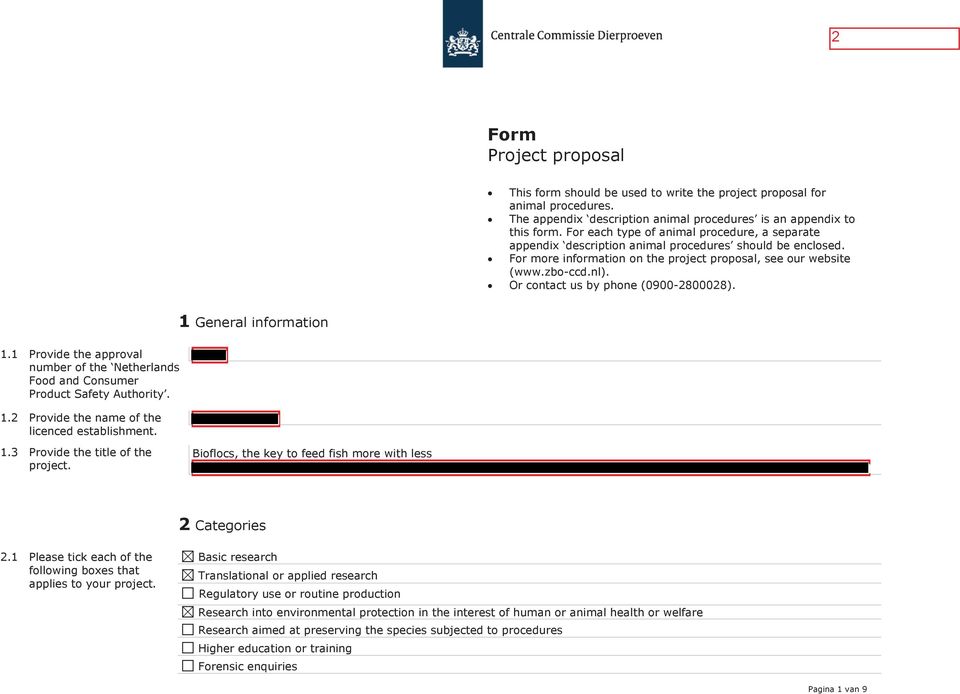
15 2 Form Project proposal This form should be used to write the project proposal for animal procedures. The appendix description animal procedures is an appendix to this form. For each type of animal procedure, a separate appendix description animal procedures should be enclosed. For more information on the project proposal, see our website ( Or contact us by phone ( ). 1.1 Provide the approval number of the Netherlands Food and Consumer Product Safety Authority. 1.2 Provide the name of the licenced establishment. 1 General information 1.3 Provide the title of the project. Bioflocs, the key to feed fish more with less 2 Categories 2.1 Please tick each of the following boxes that applies to your project. Basic research Translational or applied research Regulatory use or routine production Research into environmental protection in the interest of human or animal health or welfare Research aimed at preserving the species subjected to procedures Higher education or training Forensic enquiries Pagina 1 van 9
16 Maintenance of colonies of genetically altered animals not used in other animal procedures 3 General description of the project 3.1 Background Describe the project (motivation, background and context) with respect to the categories selected in 2. For legally required animal procedures, indicate which statutory or regulatory requirements apply (with respect to the intended use and market authorisation). For routine production, describe what will be produced and for which uses. For higher education or training, explain why this project is part of the educational program and describe the learning targets. The project is a collaboration between and focusses on bioflocs, gut microbiota and gut functioning in fish. Bioflocs are highly porous, amorphous aggregations of microorganisms, organic wastes and other constituents held together by extracellular polymeric substances. Bioflocs have been used extensively in the treatment of domestic- and industrial wastewater. The use of bioflocs as internal water purification units in aquaculture is a relatively new approach and is referred to as Biofloc Technology (BFT). In BFT the bioflocs are co-cultured together with the cultured species while the microorganisms in the bioflocs convert organic and inorganic wastes into bacterial biomass. The latter allows a production intensity which is 5 to 10 times higher than in traditional farming systems. During protein metabolism of fish and shrimp about 25% of the nitrogen present in protein is retained in the biomass of the cultured species. The remainder is lost as uneaten feed, faeces and urinary and branchial loss. Ammonia, which is a main metabolite in protein digestion, is toxic for both fish and crustaceans. This makes ammonia removal critical in maintaining a favourable water quality. BFT relies mainly on heterotrophs, which directly assimilate ammonia into microbial biomass. Direct assimilation of ammonia has an advantage over the autotrophic conversion of ammonia which is a common practice in intensive aquaculture, since no toxic metabolic intermediates and products are formed (e.g. nitrite and nitrate production during nitrification). The production of these toxic compounds makes water replacements of the culture system essential, while with BFT these compounds are stripped from the water column, reducing the need for water replacements to (nearly) nil. When managed correctly much biomass is produced in BFT systems. This is an advantage because the uptake of bioflocs from the water by the cultured species leads to an increase in nutrient retention efficiencies of 10 to 20 %. The nutrient composition of bioflocs is very much suitable to serve as a feed source, it has been shown in multiple studies that both tilapia and shrimp have a better health status and show better growth in an environment with a high concentration of naturally occurring microorganisms (see section 3.3). The exact mechanisms involved leading to the positive effect of bioflocs on the growth, health and homeostasis in aquaculture species are not yet fully understood. The current project will assess the effect of bioflocs in a bottom-up manner, first the mode of administering the bioflocs will be assessed resulting in a followup experiment in which the response to different concentrations of bioflocs in the feed will be examined. Then the active components inside the bioflocs will be evaluated to comprehend which constituents perform which function inside the gut and finally the pro- and prebiotic function of bioflocs and its components will be investigated. The latter will be investigated to evaluate possible effects of bioflocs on soya-induced enteritis (inflammation of intestine) in carnivorous fish, which is triggered by elevated levels of soya protein in the feed. Future expectations are that with development of the biobased economy in fish feeds fishmeal and fish oil will be gradually replaced by plant ingredients, some of them causing gut inflammation. The bioflocs which will be applied in Pagina 2 van 9
17 the above mentioned experiments will be produced under standardized conditions ensuring a stable source. The nutritional value of these bioflocs, which is roughly similar to fish feed on a dry matter basis, and the overall average microbial functionality are expected to remain stable throughout the experiments. An overarching objective of the project is to assess what role the microbes, derived from bioflocs, play inside the gastrointestinal tract of fish. A better understanding of these mechanisms will aid in the broader implementation of bioflocs as a feed component outside the current mode of application. The project will improve protein utilization and lead to better fish performance. In addition, more waste conversion into bioflocs means less nutrient discharge from aquaculture which will benefit the environment. These possible positive impacts can prove to be of great importance seen the resent re-adjustment in the expected world population (11 billion people by 2100), as estimated by the United Nations. Furthermore, the results of this project will improve understanding of the role microbiota play in the homeostasis and health status of fish. Project concepts might be translatable to other vertebrates, including humans. 3.2 Purpose Describe the project s main objective and explain why this objective is achievable. If the project is focussed on one or more research objectives, which research questions should be addressed during this project? If the main objective is not a research objective, which specific need(s) does this project respond to? The main goal of this project is to generate knowledge and create a deeper perception on the contribution of bioflocs to gut microbiota, gut functioning and homeostasis in fish. Due to the applicability of bioflocs (defined under 3.1) in the aquaculture sector and the recent insights on the importance of gut microbiota in vertebrates the scope of this project has a nutritional and microbial-ecological direction. This scope will enable us to fill in the knowledge gaps which have been identified prior to the start of this project. The identified knowledge gaps are: (1) Is there a difference in the effect between live or dead bioflocs on gut homeostasis in fish; (2) Which concentration of bioflocs exerts the maximum effect on gut homeostasis in fish; (3) Can we identify active principles, explaining the effect of bioflocs on gut homeostasis for example polyhydroxybutyrate (PHB) concentration (substance used in microbial energy storage); (4) Which are the principle drivers affecting the microbial species composition in bioflocs under constant and uniform aquaculture like conditions; (5) It remains challenging to increase inclusion levels of vegetarian ingredients in aquaculture feed whilst reducing the fishmeal content due to physical reactions on those vegetarian product by, especially carnivorous, fish. Could bioflocs or components in bioflocs exert a countering effect on the physical adverse reactions to diets with high levels of vegetable ingredients. During the project the following hypotheses will be tested Feeding live or dead bioflocs influences the microbial community composition in the gut but not functional stability. Fish performance (growth, feed conversion ratio (FCR), nutrient efficiency, survival) and gut homeostasis are positively affected by bioflocs concentration in the diet. PHB concentration in bioflocs has a significant effect on gut homeostasis. Inclusion of bioflocs in the diet reduces soya-induced enteritis in both herbivorous and carnivorous species Pagina 3 van 9
18 The project is exploratory and observes bioflocs, gut microbiota and gut functioning (digestion, growth, chyme content, enzyme activity in gut cells, etc.) under different treatments relevant to commercial fish husbandry. All analytical techniques are commonly used within the project team, but were never combined previously. The team will integrate the obtained data and generate new insights, advancing existing understanding of fish performance in biofloc systems. In this sense, the research feasibility is guaranteed. 3.3 Relevance What is the scientific and/or social relevance of the objectives described above? Bioflocs and biofloc technology can meet in the demand and need for less polluting and more productive food production. In addition it can contribute to food safety and security due to several aspects: Marine life evolved in presence of marine snow (white organic aggregates of alive and dead organic substances), and numerous organisms will readily consume bioflocs which are similar in appearance (although not necessarily in texture). Agricultural and aquacultural waste streams which are converted into bioflocs become a valuable, protein-rich food source for aquatic organisms. o in situ processing of metabolic wastes from fish production improves nutrient efficiency 10 to 20%, even when using lower grade and cheaper food ingredients. o numerous types of organic agricultural wastes available in bulk quantities can be converted in bioflocs, turning a waste into a food ingredient. Bioflocs make aquatic organisms healthier: o numerous experiments with bioflocs or biofilms documented better growth, survival, disease resistance and feed utilization, both for fishes and crustaceans. o animals receiving bioflocs show higher resistance to pathogens in disease challenge tests. o inclusion of bacterial biomass in diets of salmon and trout reduced soya-induced enteritis allowing higher inclusion levels of soya in exchange for fish meal without negative health effects. In this sense, biofloc technology can contribute to the improvement of fish meal use efficiency in aquaculture. Bioflocs purify water, reducing pollution and improving water use efficiency. This leads to better water quality and allows raising production intensity, heading towards sustainable zero-emission aquaculture production strategies. The project focuses on analysing shifts in microbial community structure (species composition) and function of microbiota in the gut of fishes exposed or not exposed to live or processed bioflocs. Special attention is given to the production and role of polyhydroxybutyrate in bioflocs on gut functioning. This will yield information on how bioflocs influence microbial ecology and functional stability, and as such influence homeostasis. The project includes training of one PhD and 4-6 MSc students. Project results will be shared at international conferences and project meetings, will be published in peer reviewed journals and integrated in the teaching of AFI and MIB. International exposure will strengthen the international reputation of The Netherlands as knowledge centre for green and sustainable aquaculture. Knowledge generated through the project will allow the consortium together with Dutch aqua-feed producers to develop the concept of feeding the system reducing overall feeding costs while improving nutrient use efficiencies and minimizing pollution. Pagina 4 van 9
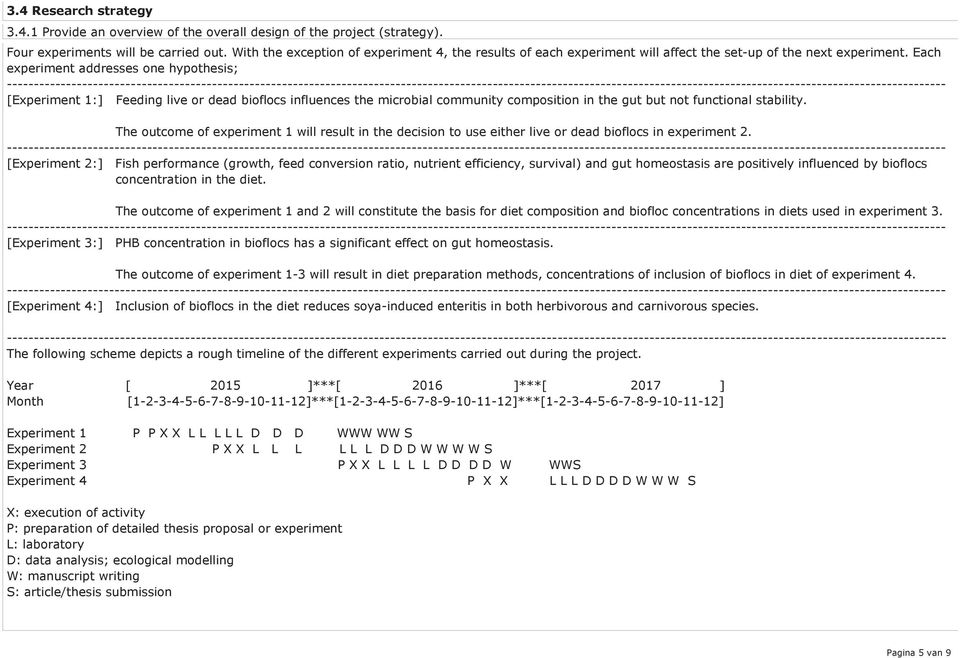
19 3.4 Research strategy Provide an overview of the overall design of the project (strategy). Four experiments will be carried out. With the exception of experiment 4, the results of each experiment will affect the set-up of the next experiment. Each experiment addresses one hypothesis; [Experiment 1:] Feeding live or dead bioflocs influences the microbial community composition in the gut but not functional stability. The outcome of experiment 1 will result in the decision to use either live or dead bioflocs in experiment [Experiment 2:] Fish performance (growth, feed conversion ratio, nutrient efficiency, survival) and gut homeostasis are positively influenced by bioflocs concentration in the diet. The outcome of experiment 1 and 2 will constitute the basis for diet composition and biofloc concentrations in diets used in experiment [Experiment 3:] PHB concentration in bioflocs has a significant effect on gut homeostasis. The outcome of experiment 1-3 will result in diet preparation methods, concentrations of inclusion of bioflocs in diet of experiment [Experiment 4:] Inclusion of bioflocs in the diet reduces soya-induced enteritis in both herbivorous and carnivorous species The following scheme depicts a rough timeline of the different experiments carried out during the project. Year [ 2015 ]***[ 2016 ]***[ 2017 ] Month [ ]***[ ]***[ ] Experiment 1 P P X X L L L L L D D D WWW WW S Experiment 2 P X X L L L L L L D D D W W W W S Experiment 3 P X X L L L L D D D D W WWS Experiment 4 P X X L L L D D D D W W W S X: execution of activity P: preparation of detailed thesis proposal or experiment L: laboratory D: data analysis; ecological modelling W: manuscript writing S: article/thesis submission Pagina 5 van 9
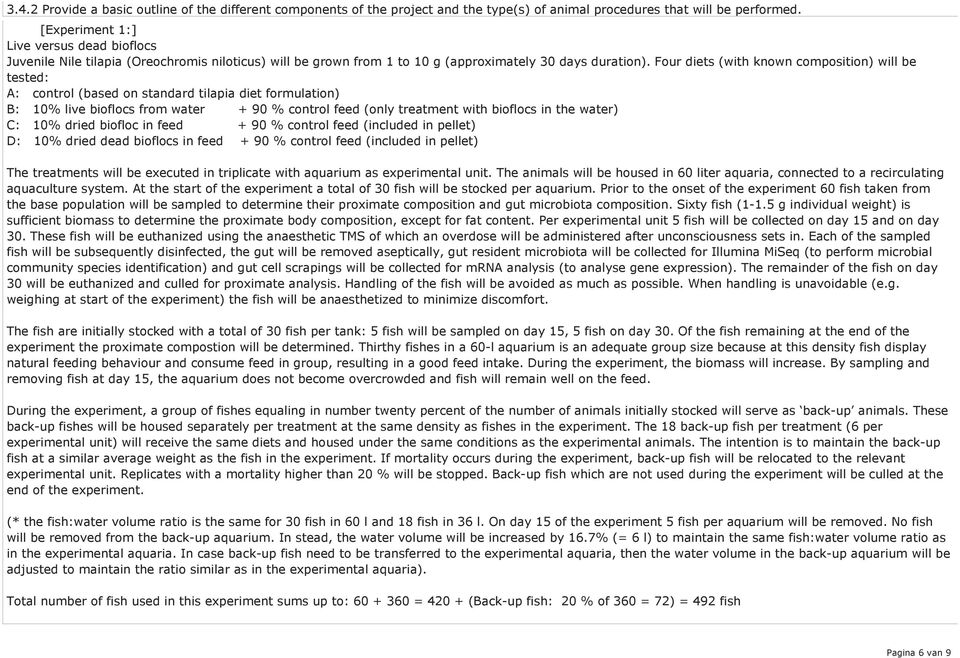
20 3.4.2 Provide a basic outline of the different components of the project and the type(s) of animal procedures that will be performed. [Experiment 1:] Live versus dead bioflocs Juvenile Nile tilapia (Oreochromis niloticus) will be grown from 1 to 10 g (approximately 30 days duration). Four diets (with known composition) will be tested: A: control (based on standard tilapia diet formulation) B: 10% live bioflocs from water + 90 % control feed (only treatment with bioflocs in the water) C: 10% dried biofloc in feed + 90 % control feed (included in pellet) D: 10% dried dead bioflocs in feed + 90 % control feed (included in pellet) The treatments will be executed in triplicate with aquarium as experimental unit. The animals will be housed in 60 liter aquaria, connected to a recirculating aquaculture system. At the start of the experiment a total of 30 fish will be stocked per aquarium. Prior to the onset of the experiment 60 fish taken from the base population will be sampled to determine their proximate composition and gut microbiota composition. Sixty fish (1-1.5 g individual weight) is sufficient biomass to determine the proximate body composition, except for fat content. Per experimental unit 5 fish will be collected on day 15 and on day 30. These fish will be euthanized using the anaesthetic TMS of which an overdose will be administered after unconsciousness sets in. Each of the sampled fish will be subsequently disinfected, the gut will be removed aseptically, gut resident microbiota will be collected for Illumina MiSeq (to perform microbial community species identification) and gut cell scrapings will be collected for mrna analysis (to analyse gene expression). The remainder of the fish on day 30 will be euthanized and culled for proximate analysis. Handling of the fish will be avoided as much as possible. When handling is unavoidable (e.g. weighing at start of the experiment) the fish will be anaesthetized to minimize discomfort. The fish are initially stocked with a total of 30 fish per tank: 5 fish will be sampled on day 15, 5 fish on day 30. Of the fish remaining at the end of the experiment the proximate compostion will be determined. Thirthy fishes in a 60-l aquarium is an adequate group size because at this density fish display natural feeding behaviour and consume feed in group, resulting in a good feed intake. During the experiment, the biomass will increase. By sampling and removing fish at day 15, the aquarium does not become overcrowded and fish will remain well on the feed. During the experiment, a group of fishes equaling in number twenty percent of the number of animals initially stocked will serve as back-up animals. These back-up fishes will be housed separately per treatment at the same density as fishes in the experiment. The 18 back-up fish per treatment (6 per experimental unit) will receive the same diets and housed under the same conditions as the experimental animals. The intention is to maintain the back-up fish at a similar average weight as the fish in the experiment. If mortality occurs during the experiment, back-up fish will be relocated to the relevant experimental unit. Replicates with a mortality higher than 20 % will be stopped. Back-up fish which are not used during the experiment will be culled at the end of the experiment. (* the fish:water volume ratio is the same for 30 fish in 60 l and 18 fish in 36 l. On day 15 of the experiment 5 fish per aquarium will be removed. No fish will be removed from the back-up aquarium. In stead, the water volume will be increased by 16.7% (= 6 l) to maintain the same fish:water volume ratio as in the experimental aquaria. In case back-up fish need to be transferred to the experimental aquaria, then the water volume in the back-up aquarium will be adjusted to maintain the ratio similar as in the experimental aquaria). Total number of fish used in this experiment sums up to: = (Back-up fish: 20 % of 360 = 72) = 492 fish Pagina 6 van 9
21 Samples taken will include: Sampling of 60 fish taken from the base population to determine their proximate composition and gut microbiota composition. Samples of microbial communities in bioflocs, feed, culture water and gut (mucus & feces; 5 individuals per sampling day) will be taken on day 15 and day 30. Samples will be used to monitor microbial community composition and enzyme production by next generation sequencing of 16S rrna gene fragments and the metatranscriptome (total mrna). Daily monitoring of water quality in inlet water to fish tanks (temp., ph, total ammonia nitrogen (TAN), NO2, NO3, CO2, conductivity). Histology: gut samples taken at start and end experiment Short chain fatty acids (SCFA s): gut and biofloc (fresh & processed) samples start and end Remaining fishes will be culled at the end of the experiment and used for proximate analysis. Fish will grow to 8-10 g individual weight at the end of the experiment. A total biomass of g is just sufficient to perform a complete proximate analysis. The choice to sample 5 fish per sampling point per experimental unit was made for statistical reasons, because from previous experiments performed by Giatsis et al. (2014)** we know that 5 fish per sampling provides sufficient statistical power with the proposed statistical- (e.g. PERMANOVA) and bioinformatical methods. Using 3 fish per sampling point (6 possible unique permutations) results in a minimum statistical probability of >10%. When using 4 fish per sampling point (24 unique permutations) the minimum statistical probability is 4.2 %. The minimum probabilities with both 3 and 4 fish per sampling point is too high, while using 5 fish per sampling point (120 unique permutations) results in a maximum probability < 1 % which is adequate. The tilapia used in treatment B are held in water containing bioflocs. By nature, tilapia are capable of filter feeding and can withstand high concentrations of suspended solids in the water. The animal procedures which will be performed on the fish do not exert negative effects on fish comfort. All treatments will impose mild discomfort. [Experiment 2:] Dose response experiment of biofloc concentration in diet on gut homeostasis. Whether live or dead bioflocs will be used depends on the outcome of experiment 1. Four different biofloc concentrations in the diet will be tested. The concentrations tested will also be decided based on the outcome of experiment 1. Group sizes and sampling protocols will be the same as for experiment 1. All treatments will impose mild discomfort. [Experiment 3:] Active principle Two modes of action will be explored: Polyhydroxybutyrate: comparing effect of pure grade and biofloc-based PHB at different concentrations. Preparation-administration method of bioflocs. Depending on outcome of experiment 1 the methods are: o live bioflocs: filter from water, paste (with binder). o dead biofloc: dried, freeze dried and y-radiated. Group sizes and sampling procedures will be same as with experiment 1. Sampling will focus on microbial composition, enzyme production and SCFA s. All treatments will impose mild discomfort. [Experiment 4:] Reducing soya-induced enteritis through bioflocs The composition of test diets will be based on experiences gained in the previous experiments. Besides tilapia, rainbow trout (carnivorous fish) will be Pagina 7 van 9
22 tested. Group sizes per replicate and sampling procedures will be the same as for experiment 1. It is to be expected that the animals used in the control group of experiment 4 will develop enteritis due to elevated levels of soya in the diet, the level of discomfort is estimated to be moderate. The latter is unavoidable due to the need of a positive control to test the beneficial nature of bioflocs on soyainduced enteritis. The discomfort imposed on the fish of the other treatments is estimated to be mild. The total number of animals used during the project sums up to: Nile tilapia: Experiment 1: 60 fish for initial state + (4 * 3 * 30 = 360 fish) = 420 fish Back-up fish: 20 % of 360 = 72 fish Experiment 2: 60 fish for initial state + (4 * 3 * 30 = 360 fish) = 420 fish Back-up fish: 20 % of 360 = 72 fish Experiment 3: 60 fish for initial state + (4 * 3 * 30 = 360 fish) = 420 fish Back-up fish: 20 % of 360 = 72 fish Experiment 4: 60 fish for initial state + (4 * 3 * 30 = 360 fish) = 420 fish + Back-up fish: 20 % of 360 = 72 fish fish 288 fish Rainbow trout: Experiment 4: 60 fish for initial state + 4 * 3 * 30 = 360 fish = 420 fish Back-up fish: 20 % of 360 = 72 fish Total use of experimental animals during project: 2100 fish Total use of experimental animals during project: 360 fish fish At the start of each experiment 60 fish of the base population of Nile tilapia or rainbow trout will be sampled for proximate analysis. In total 240 Nile Tilapia and 60 rainbow trout will be used. ** Giatsis, C., Sipkema, D., Smidt, H., Verreth, J., Verdegem, M., The Colonization Dynamics of the Gut Microbiota in Tilapia Larvae. PloS one. 9, e Describe the coherence between the different components and the different steps of the project. If applicable, describe the milestones and selection points. As described in section and the experiments 2, 3 and 4 are all follow-up experiments. Every outcome of an experiment will be a milestone and decision point for the experimental design of its successor. Experiment 1; live or dead bioflocs milestone; dead or live flocs Experiment 2; dose-response milestone; diet composition and biofloc concentration Pagina 8 van 9
23 Experiment 3; active principle milestone; preparation methods, concentrations, duration Experiment 4; Reducing soya-induced enteritis List the different types of animal procedures. Use a different appendix description animal procedures for each type of animal procedure. Serial number Type of animal procedure 1 Responce to nutrition and feeding experiment Pagina 9 van 9
24 3 Appendix Description animal procedures This appendix should be enclosed with the project proposal for animal procedures. A different appendix description animal procedures should be enclosed for each type of animal procedure. For more information, see our website ( Or contact us by phone ( ). 1.1 Provide the approval number of the Netherlands Food and Consumer Product Safety Authority. 1.2 Provide the name of the licenced establishment. 1 General information 1.3 List the serial number and type of animal procedure. Use the serial numbers provided in Section of the Project Proposal form. Serial number Type of animal procedure 1 Response to nutrition and feeding experiment 2 Description of animal procedures A. Experimental approach and primary outcome parameters Describe the general design of the animal procedures in relation to the primary outcome parameters. Justify the choice of these parameters. Each experiment has a total duration of 30 days. In each experiment, fish stocked per aquarium will be batch weighted and counted at stocking and harvesting in order to calculate the average individual Pagina 1 van 8
25 weight and growth. The individual weight of the five fish taken for gut sampling on day 15 and 30 will also be measured. A minimum stocking density of 30 fish per experimental unit was chosen to obtain sufficient biomass for proximate analyses at the end of the experiment. Husbandry conditions: The husbandry setup will be the same for each experiment. Fish are housed in 60 liter (effective volume) aquaria integrated in a recirculating aquaculture system to maintain water quality. Fish behaviour and water quality will be checked on a daily basis conform standard procedures, using the clinical score sheet recording system. A detailed experimental protocol, outlining all procedures, will be attached to the clinical score sheet for each experiment. For experiment 4, trout and tilapia will be housed in different recirculating aquaculture systems, considering difference in temperature and water quality requirements. Experiment 1: Juvenile tilapia (1 g individual start weight) will be used to determine the effect of life and dead bioflocs on gut functioning. A total of 4 experimental diets will be used with a set concentration of: (1) dried dead biofloc; (2) dried bioflocs; (3) ingredients matching biofloc composition and (4) a concentration of "fresh" bioflocs from the water, treatments will be executed in triplicate. The animals will be housed in 60-ler aquaria with a total of 30 fish per aquarium at the start of the experiment. At the start of the experiment 60 fish taken from the base population will be sampled to determine their proximate composition and gut microbiota composition before the onset of the experiment. Sixty fish (1-1.5 g individual weight) are needed to provide sufficient biomass to determine the proximate composition, except for fat. Per experimental unit 5 fish will be collected on day 15 and on day 30. These fish will be euthanized using the anaesthetic TMS of which an overdose will be administered after unconsciousness sets in. Each of these fish will be subsequently disinfected, the gut will be removed aseptically, gut resident microbiota will be collected for Illumina MiSeq (to perform microbial community species identification) and gut cell scrapings will be collected for mrna analysis (to analyse gene expression). The remainder of the fish will be euthanized on day 30 and culled for proximate analyses. Handling of the fish will be avoided as much as possible. When handling is unavoidable (e.g. weighing at start of the experiment) the fish will be anaesthetized to minimize discomfort. Experiment 2: Juvenile tilapia (1 g individual start weight) will be used to determine the effect of biofloc dose in the diet on gut homeostasis. Four different experimental diets will be tested. The concentrations of bioflocs and whether dead or live bioflocs will be used depends on the outcome of experiment 1. Group size and sampling procedures will be the same as for experiment 1. Experiment 3: Juvenile tilapia (1 g individual start weight) will be used to determine the effect of both pure grade and biofloc derived PHB in the diet on gut homeostasis and functioning. Group size and sampling procedures will be the same as for experiment 1. Experiment 4: Nile tilapia and rainbow trout (1 g individual start weight) will be used to determine the reducing effects of bioflocs on soya induced enteritis. The composition of test diets will be based on experience gained during previous experiments. Sampling procedures will be the same as for experiment 1. Describe the proposed animal procedures, including the nature, frequency and duration of the treatment. Provide justifications for the selected approach. The Nile tilapia will be obtained from Til-Aqua (Velden, the Netherlands), the rainbow trout will be obtained from Mohmen GmbH (Stolberg-Gressenich, Pagina 2 van 8
26 Germany). The tilapia will arrive when they are approximately 0.1 gram individual weight. The trout will be approximately gram individual weight at arrival, depending on availability. After arrival, fish will be stocked according to the general protocol and receive a larval commercial diet until they reach the wanted individual start weight of 1 g. Twenty percent of the number of animals used in the experiment will serve as back-up animals. A total of 18 fish per treatment (6 per experimental unit) will receive the same diets and housing conditions as the experimental animals. The intention is to maintain the back-up fish at a similar average weight as the experimental fish. If mortality occurs, back-up fish will be relocated to the relevant experimental unit. Replicates with a mortality higher than 20 % will be stopped. Back-up fish which are not used during the experiment will be culled at the end of the experiment. At the start of each experiment the 1 g fish will be gently caught using a small net. Subsequent to that, the fish will be mildly sedated using TMS after which the fish will be weighted. A total of 60 fish will receive an additional dose of TMS. When euthanized they will be sampled for initial state analyses. The experimental animals will be randomly assigned to the experimental units. Random assignment of fish to the experimental units will be done by taking the 360 fish one by one and using randomly generated numbers without repetition between 1 and 360 per fish (Iphone application 'random #'). Fish 1-30 will be stocked in aquarium 1, in aquarium 2, etc. While distributing the 360 fish in 12 batches of 30 fish, the fish are anesthetized and each of the 12 batches will be stocked in a separate bucket. After the fish regain consciousness in the buckets, they will be transferred to the assigned aquarium. At day 15 and 30 five randomly assigned fish will be gently caught and euthanized using TMS of which an overdose will be administered after unconsciousness sets in. The fish are kept in a 12:12 hr light dark regime The fish will be fed twice daily with appropriate and full diets. An exception to the latter are the diets of experiment 4. These treatments will receive a high dose of soya in the diet, the control group of rainbow trout is expected to experience moderate discomfort due to soya-induced enteritis. Based on literature, it is to be expected that the experimental treatments besides the control will not experience this discomfort due to the positive effects of the bioflocs added to the diets. Besides the above describes procedures the fish will not be disturbed. Describe which statistical methods have been used and which other considerations have been taken into account to minimise the number of animals. The choice to sample 5 fish per sampling point per experimental unit was made for statistical reasons, because from previous experiments performed by Giatsis et al. (2014)* we know that 5 fish per sampling provides sufficient statistical power with the proposed statistical- (e.g. PERMANOVA) and bioinformatical methods. Using 3 fish per sampling point (6 possible unique permutations) results in a minimum statistical probability of > 10%. When using 4 fish per sampling point (26 unique permutations) the minimum statistical probability is 4.2 %. The minimum probabilities with both 3 and 4 fish per sampling point is too high, while using 5 fish per sampling point (120 unique permutations) will results in a maximum probability <1 % which is adequate. note: Giatsis, C., D. Sipkema, H. Smidt, J. Verreth and M. Verdegem (2014). "The Colonization Dynamics of the Gut Microbiota in Tilapia Larvae." PLoS ONE 9(7): e B. The animals Specify the species, origin, estimated numbers, and life stages. Provide justifications for these choices. Animals used: Pagina 3 van 8
27 Nile tilapia (Oreochromis niloticus, silver/wild type, natural all male population) Rainbow trout (Oncorhynchus mykiss, wild type) Origin: Nile tilapia: Til-Aqua, Velden, the Netherlands Rainbow trout: Mohmen GmbH (Stolberg-Gressenich, Germany) Estimated number: Nile tilapia: Experiment 1: 60 fish for initial state + (4 * 3 * 30 = 360 fish) = 420 fish Back-up fish: 20 % of 360 = 72 fish Experiment 2: 60 fish for initial state + (4 * 3 * 30 = 360 fish) = 420 fish Back-up fish: 20 % of 360 = 72 fish Experiment 3: 60 fish for initial state + (4 * 3 * 30 = 360 fish) = 420 fish Back-up fish: 20 % of 360 = 72 fish Experiment 4: 60 fish for initial state + (4 * 3 * 30 = 360 fish) = 420 fish + Back-up fish: 20 % of 360 = 72 fish fish 288 fish Rainbow trout: Experiment 4: 60 fish for initial state + 4 * 3 * 30 = 360 fish = 420 fish Back-up fish: 20 % of 360 = 72 fish Total use of experimental animals during project: 2100 fish Total use of experimental animals during project: 360 fish fish At the start of each experiment 60 fish of the base population of Nile tilapia or rainbow trout will be sampled for proximate analysis. In total 240 Nile Tilapia and 60 rainbow trout will be sampled before the onset of the experiments. Life stages: Experiment 1-4: 1-10 gram fish individual weight Groups of 30 fish are stocked because this is the number of fishes sampled and analyzed: 5 fish sampled on day 15, 5 fish sampled on day 30 and the proximate composition of the remaining 20 fish will be determined at the end of the experiment. Housing 30 fish in a 60-l aquarium is adequate for fish to display good feeding behaviour. Within a few days after stocking the fish will be adapted to the housing conditions and feeding schedule. Per experimental unit 5 fish will be collected on day 15 and on day 30. During the experiment, the biomass increases. By culling fish at day 15, the aquarium does not become overcrowded and fish will remain well on the feed. Previous experiments showed that a sample size of 5 animals is sufficient for statistical analysis of this type of data (Giatsis et al. 2014; see end of section A). The remaining 20 animals will be used for proximate analyses (to determine growth and nutrient efficiency in the different treatments). The g total fish biomass of the 20 fish collected at the end of the experiment is just sufficient to perform proximate analysis. The choice for tilapia as an experimental animal is a logical consequence of the importance of this species to worldwide aquaculture, the current use of this Pagina 4 van 8
28 kind in biofloc systems and their nature as a filter feeder. Much is known about tilapia and most literature available regarding fish farming in biofloc systems is based on experiments with shrimp or tilapia. During the last experiment rainbow trout and Nile tilapia will be used to elaborate the effects of bioflocs, or its components, on the gut functioning and health of carnivorous fish. C. Re-use Will the animals be re-used? No, continue with question D. Yes > Explain why re-use is considered acceptable for this animal procedure. Are the previous or proposed animal procedures classified as severe? No Yes> Provide specific justifications for the re-use of these animals during the procedures. D. Replacement, reduction, refinement Describe how the principles of replacement, reduction and refinement were included in the research strategy, e.g. the selection of the animals, the design of the procedures and the number of animals. Little is known about the influences of bioflocs on the health and growth of fish. Due to the complexity of the processes in the intestine of fish, in this case there is a need for in situ research. Unfortunately there is no alternative for using fish to answer the fundamental issues addressed in the project. Groups of 30 fish are stocked because at a lower density it is difficult to get all fish to react well to the administrated feed. Within a few days fish get adapted to the housing conditions and feeding schedule. Per experimental unit 5 fish will be collected on day 15 and on day 30. During the experiment, the biomass increases. By culling fish at day 15, the aquarium does not become overcrowded and fish will remain well on the feed. Previous experiments showed that a sample size of 5 animals is sufficient for statistical analysis of this type of data (Giatsis et al. 2014; see end of section A). The remaining 20 animals will be used for proximate analyses (to determine growth and nutrient efficiency in the different treatments). The biomass of the 20 fish collected at the end of the experiment ( g total weight) represents the minimum sample size required. The number of laboratory animals used in the experiment is the minimum number required to obtain the number and size of samples needed for the analytical analyses. The experimental diets fed to the fish are complete diets providing all necessary macro and micro nutrients. If more than 20 % of the fish stocked in an aquarium died, the remaining fish in the aquarium will be culled (In other words, one replicate of a treatment will be stopped). Fishes of 1-10 g rarely display external signs of disease and quickly die under adverse conditions. Therefore, mortality of 20% of fishes in a group was set as human end-point. Explain what measures will be taken to minimise 1) animal suffering, pain or fear and 2) adverse effects on the environment. Fish will be stocked with 30 fish per experimental unit, in this way natural feeding behaviour can be displayed. During the experiment, the biomass increases. By culling fish at day 15, the aquarium does not become overcrowded and fish will remain well on the feed. Water quality parameters will be kept at an adequate level. Handling the fish will be kept to a minimum, when handling cannot be avoided fish will be treated with an anaesthetic. No adverse effects on the environment are expected to occur during this project. Pagina 5 van 8
29 Repetition and duplication E. Repetition Explain what measures have been taken to ensure that the proposed procedures have not already been performed. If applicable, explain why repetition is None of the experiments proposed has been executed previously. This is ensured by in-depth consultation with colleagues working in the same field and extensive literature research. Accommodation and care F. Accommodation and care Is the housing and care of the animals used in experimental procedures not in accordance with Annex III of the Directive 2010/63/EU? No Yes > If this may adversely affect animal welfare, describe how the animals will be housed and provide specific justifications for these choices. G. Location where the animals procedures are performed Will the animal procedures be carried out in an establishment that is not licenced by the NVWA? No > Continue with question H. Yes > Describe this establishment. Provide justifications for the choice of this establishment. Explain how adequate housing, care and treatment of the animals will be ensured. H. Pain and pain relief Will the animals experience pain during or after the procedures? No > Continue with question 1. Yes > Will anaesthesia, analgesia or other pain relieving methods be used? No > Justify why pain relieving methods will not be used. Classification of discomfort/humane endpoints During experiment 4 the fed diets will contain soya. Soya rich diets induce enteritis. In our experiment, the level of inflammation will be highest in the control diet. Microbiota are known to reduce development of enteritis and bioflocs are rich aggregates of microbes. Hence, in the other treatments fish discomfort is expected to be less. The soya inclusion level in the control will be such that the inflammation level will be moderate. Antiinflammatory substances or pain relieving medication cannot be used because this would counter the expected physical reaction. Pagina 6 van 8
30 Yes I. Other aspects compromising the welfare of the animals Describe which other adverse effects on the animals welfare may be expected? No other aspects other than 'mild' or 'moderate' as described under K. are expected during execution of the experiments. Carus has a backup power unit in case of energy failure. A disease outbreak cannot be fully prevented. Explain why these effects may emerge. Disease outbreak: not possible to hypothesize at this point in time. Common causes are cross infection with other experiments in Carus, intake of new fish already carrying the disease; etc. Indicate which measures will be adopted to prevent occurrence or minimise severity. Disease outbreak: experiments in separate room; follow strictly hygiene protocols; disinfection of experimental units prior to start of experiments; obtain experimental fish from trustworthy sources; follow quarantine procedures of Carus for newly obtained fish; consultation with the experimental animal expert of WU (drs. R. Steenmans) in case of observed abnormal fish behaviour or disease outbreak. J. Humane endpoints May circumstances arise during the animal procedures which would require the implementation of humane endpoints to prevent further distress? No > Continue with question K. Yes > Describe the criteria that will be used to identify the humane endpoints. If circumstances such as a disease outbreak cause more than 20% mortality in one or more experimental units fish will be, after consulting the experimental animal expert, euthanized to prevent further distress. Continuation or termination of the experiment in such a case will be decided in consultation with drs. R. Steenmans. Fishes of 1-10 g rarely display external signs of disease and quickly die under adverse conditions. Therefore, mortality of 20% of fishes in a group was set as human end-point. Animals will be checked daily for signs of distress: feeding and swimming behavior, signs of lethargy and external signs (skin and fin damage & coloration, external infections, eye color, etc.) Indicate the likely incidence. The possibility of a mortality exceeding the proposed maximum level of 20 % is very small. The severity of discomfort any treatment will impose on the fish are targeted to be moderate (through experimental design) and are highly unlikely to cause mortality. K. Classification of severity of procedures Provide information on the expected levels of discomfort and indicate to which category the procedures are assigned ( non-recovery, mild, moderate, severe ). All procedures as elucidated under section A are expected to cause mild discomfort at maximum. An exception to this is that during experiment 4 the fed diets will contain elevated levels of soya-protein. This will most probably induce enteritis, the severity of this condition will be highest in the control diet. In the control the maximum inclusion level is used without the presence of bioflocs, which are known to have a beneficial effect on enteritis. The fish of this group will suffer moderate discomfort due to the inflammation. At the end of the experiments all fish will be anesthetized and killed. In summary: *Experiment 1: all treatments mild discomfort *Experiment 2: all treatments mild discomfort *Experiment 3: all treatments mild discomfort *Experiment 4: control treatment moderate discomfort; all other treatments mild discomfort Pagina 7 van 8
31 L. Method of killing Will the animals be killed during or after the procedures? No > Continue with Section 3: signatures. End of experiment Yes > Explain why it is necessary to kill the animals during or after the procedures. The gut microbiome, transcriptome and enzymatic activity of the 5 animals per experimental unit sampled on day 15 and 30. The animals will be killed before dissecting out the gut. The fish used in proximate analyses on day 0 and 30 will be killed prior to analyses. The number of fish stocked in each experimental unit is such that all experimental animals are used in analyses. Is the proposed method of killing listed in Annex IV of Directive 2010/63/EU? No > Describe the method of killing that will be used and provide justifications for this choice. Yes Pagina 8 van 8
32 4 > Retouradres Postbus EK Den Haag Centrale Commissie Dierproeven Postbus EK Den Haag T (10 ct /min) [email protected] Onze referentie Uw referentie Datum 23 maart 2015 Betreft Aanvullende informatie vergunningsaanvraag Bijlagen Geachte, Op 13 februari 2015 hebben wij uw aanvraag voor een projectvergunning dierproeven ontvangen. Het gaat om uw project Bioflocs, the key to feed fish more with less. De aanvraag is momenteel bij ons in behandeling en wij hebben een aantal aanvullende vragen om de beoordeling af te kunnen ronden. Welke informatie nog nodig Wij hebben de volgende informatie van u nodig: 1: In het project proposal formulier wordt bij experiment 1 van vier andere voedselregimes uitgegaan dan in het animal procedures formulier. Welke is de juiste? 2: In de navolgende experimenten is de keuze en opzet voor 4 groepen met een ander regime niet duidelijk. Anders gezegd: licht toe op welke wijze a priori al de keuze gemaakt kan worden voor vier voedselregimes per experiment. 3: Het OBDA wil graag beargumenteerd zien wat go en no-go momenten zijn die de onderzoekers doen besluiten om door te gaan naar het volgende experiment en in welke vorm. 4: De redenatie achter het aantal backup-dieren is niet geheel duidelijk. Licht toe wat de bandbreedte is in verwachte uitval in reguliere kweek. Is er ook additionele sterfte te verwachten door de behandelingen? Het is wel evident dat de biomassa in de testbakken gelijk moet blijven omdat anders de groei van de dieren in elke replica beïnvloed wordt door een andere biomassa-water verhouding. 5: Om welke reden is bij bepalingen achteraf een veel hogere biomassa nodig dan aan het begin van het experiment? Pagina 1 van 2
33 6: Over enteritis bij experiment 4: De ongeriefsinschatting op de NTS en het description animal procedures formulier zijn niet consistent. Geef de beschrijving die volgens u juist is en pas zo nodig de NTS aan. Datum 23 Februari 2015 Onze referentie Opsturen informatie De CCD zou de gevraagde informatie graag zo snel als mogelijk, doch binnen de voorgeschreven termijn van 14 dagen van u ontvangen. Totdat de antwoorden binnen zijn, staat de behandeltijd stil. U kunt deze informatie aanleveren via NetFTP of per post. Indien u de informatie per post verstuurd, gebruik dan het bijgevoegde formulier. Wanneer een beslissing Zodra wij de aanvullende informatie hebben ontvangen, nemen wij uw aanvraag verder in behandeling. Als u goedkeuring krijgt op uw aanvraag, kunt u daarna beginnen met het project. Meer informatie Heeft u vragen, kijk dan op Of neem telefonisch contact met ons op: (10 ct/minuut). Met vriendelijke groet, Centrale Commissie Dierproeven Deze brief is automatisch aangemaakt en daarom niet ondertekend. Bijlage: - formulier Melding Bijlagen via de post Pagina 2 van 2
34
35
36
37 6 &'&' () ##)" 4,5 78&" 5*9 * 8# +)" #!"! 6* 5 #9!! * 89,8" ##:)#,65!;))5"*5#< (95 * 5*9 = ## )" *95" ))# 3 =,55 #,!8'5##9! >,5* *,5 ##!*!?! #)*,55 #@*# "!!#9!"#9" #!8#, A#* " '* 5?* *)* " #5 # +!* *,5B 8 * # # *,57!*,5 5 # B,!8'5!88#5" 89 " B) ' ##,55## #*,5@ '! # "5 #8)"B,!' " 8 B5 6 #9!65)# #@ CC+ )" +# #"#9!,5 #9!,58!+)" # D)88?)" 886! 59)"# ***+',,# -'../,0"1 )2+',,# &
38 E *9 ##)" 5 6"*9* 5 # #!!98* 6! "589, ) 6!9! 8***+',,#7)"#),5,," 8=-../,0"1 F#9!6 C #C""8 +) ",5 "! "! (9# = ' )"#F#(9# 8 &'&' &
39 3# (9*#! 5 #!9# "@ * (9# 8 +F#(9# 9* *#!," +95#,"8 F)" 8***+',,# 7)#"=-../,0"1 D ", "" "" (9# & 7!5)"# 5" ##9# 8 = C #C"" 8 7! D " "! ''
40 7 Centrale Commissie Dierproeven Postbust EK Den Haag Beste leden van de CCD, De volgende vraag werd gesteld: In uw antwoord [op vraag 4] geeft u weer dat de mortaliteit die door de behandeling veroorzaakt wordt naar verwachting 0% is. Er is nog niet ingegaan op de vraag wat de reguliere uitval naar verwachting is. Ook niet wat de redenatie is achter het getal van 20% backup-dieren en het daaraan gekoppelde humane eindpunt bij meer dan 20% sterfte. -Kunt u alsnog toelichten hoeveel reguliere uitval u verwacht? -kunt u alsnog de redenatie geven om het aantal proefdieren met 20% aan back-up dieren te verhogen en daarbij het humane eindpunt van 20% te hanteren, ter verduidelijking, dus niet een hoger of lager getal? Antwoord: Onze ervaring is dat reguliere uitval bij normale houderij bij deze soorten in dit groeitraject (1 10 g) gemiddeld 5% is (proefaccommodatie standaard, Echter, bij sommige proeven krijgen we te maken met hogere sterfte. Dit kan zijn door een probleem met het houderij-systeem (e.g. pomp defect, verstopte overloop,...) of door het optreden van een infectie. Technisch problemen worden meestal snel opgelost. Bij uitval door ziekte houden we 20% aan als humaan eindpunt, omdat: Er duidelijk onderscheid gemaakt moet kunnen worden tussen reguliere uitval en uitval door ziekte. Door variatie tussen experimentele units ligt reguliere uitval meestal beduidend onder de 5%, maar kan ook oplopen in uitzonderlijke gevallen tot 10 15%. Een humaan eindpunt van 20% onderscheid zich met zekerheid van reguliere uitval (= reden voor niet een lager percentage dan 20%). Dagelijkse observaties van gedrag van visgroepen in experimentele units laten toe snel onregelmatigheden, en een mogelijk ziekte uitbraak te voorspellen. Dit laat toe snel maatregelen te nemen, inclusief contact opnemen met de artikel 14 proefdierdeskundige Als desondanks de ziekteontwikkeling doorzet, en sterfte uitstijgt boven 20%, dan geeft dit aan dat genomen maatregelen niet effectief waren en dat meer dieren zullen lijden onder de ziekte. Dan is het beter de experimentele unit in overleg met de proefdierdeskundige uit de proef te verwijderen om verder lijden te voorkomen (= reden voor niet een hoger percentage). Zieke dieren hebben minder eetlust en zijn minder actief dan gezonde dieren. Dit project gaat om onderzoek waarbij voedselopname en groei belangrijke
41 2 uitleesparameters zijn. Bij hoge uitval door ziekte worden onderzoeksresultaten niet meer representatief (= extra reden voor stopzetten bij bereiken van 20% uitval). Yours sincerely, cc.: IvD
42 8 Format DEC-advies A. Algemene gegevens over de procedure 1. Aanvraagnummer 2. Titel van het project: Bioflocs, the key to feed fish more with less 3. Titel van de NTS: Meer met minder / Bioflocs, the key to feed fish more with less 4. Type aanvraag: nieuwe aanvraag projectvergunning 5. Contactgegevens DEC: - Naam: - telefoonnummer contactpersoon: - mailadres contactpersoon: 6. Adviestraject: ontvangen door DEC: aanvraag compleet: ja in vergadering besproken: anderszins behandeld: nee termijnonderbreking(en) van tot van tot aanpassing aanvraag: ja (zie 8.) advies aan CCD Eventueel horen van aanvrager: nee 1
43 8. Correspondentie met de aanvrager - Datum De DEC heeft vragen gesteld m.b.t.: Een uitvoerigere onderbouwing van het aantal benodigde dieren, zowel voor de proefgroepen als voor de reservedieren; Een explicietere beschrijving van humane eindpunten (indicatoren); Een uitgebreidere toelichting in de niet-technische samenvatting bij vervanging op de vraag waarom er geen alternatief voorhanden is; Enkele redactionele opmerkingen. - Datum antwoord Strekking van het (de) antwoord(en) Op basis van bovenstaande vragen is de projectaanvraag door de aanvrager aangepast. In de huidige versie is voldoende tegemoet gekomen aan de vragen van de DEC. 9. Eventuele adviezen door experts (niet lid van de DEC): N.v.t. B. Beoordeling (adviesvraag en behandeling) 1. Het project is vergunningplichtig (dierproeven in de zin der wet). 2. De aanvraag betreft een nieuwe aanvraag. 3. De DEC is competent om hierover te adviseren. 4. Vanwege betrokkenheid bij het betreffende project is een aantal DEC-leden, met het oog op onafhankelijkheid en onpartijdigheid, niet betrokken bij de advisering: n.v.t. C. Beoordeling (inhoud): 1. Het project is: uit wetenschappelijk oogpunt verantwoord. uit onderwijskundig oogpunt verantwoord: het onderzoek heeft primair niet een onderwijskundig doel, maar het betreft een PhD-project, waar ook MSc-studenten bij worden betrokken. 2
44 2. De in de aanvraag aangekruiste doelcategorie(ën) zijn in overeenstemming met de hoofddoelstelling(en). 3. De DEC onderschrijft het belang van de doelstelling. Het wordt ingeschat als een reëel belang. De DEC is van mening dat het project kan bijdragen aan wetenschappelijk inzicht in en mogelijkheden tot verbetering van voeding en (darm)gezondheid bij vis door het gebruik van biovlokken. Tevens draagt het bij aan een vermindering van het eiwitgebruik in de visteelt, hetgeen vanuit het streven naar duurzame productie een maatschappelijke relevantie heeft. 4. De gekozen strategie en experimentele aanpak kunnen leiden tot het behalen van de doelstelling binnen het kader van het project. 5. Er is geen sprake van bijzonderheden op het gebied van categorieën van dieren, omstandigheden of behandeling van de dieren. 6. Het ongerief als gevolg van de dierproeven is realistisch ingeschat en geclassificeerd. Het betreft een voerproef, waarbij verschillende diëten worden onderzocht en waarbij de vissen onder normale condities worden gehouden. Vooréén behandelingsgroep is het ongerief ingeschat op matig ongerief. De overige dieren worden niet blootgesteld aan extra proefdierkundige handelingen, die meer dan gering ongerief kunnen veroorzaken. 7. Er zijn geen methoden die de voorgestelde dierproeven geheel of gedeeltelijk zouden kunnen vervangen. De onderzochte processen en interacties zijn alleen te bestuderen in levende dieren en kunnen niet nagebootst worden buiten het dier. 8. In het project wordt optimaal tegemoet gekomen aan de vereiste van de vermindering van dierproeven. Het maximale aantal te gebruiken dieren is realistisch ingeschat. De gekozen aantallen zijn minimaal nodig om de benodigde analyses te kunnen uitvoeren. De aanvrager beschikt over voldoende expertise en informatie om, bij wettelijk vereist onderzoek, te voorkomen dat onnodige duplicatie plaatsvindt. 9. Het project is in overeenstemming met de vereiste van de verfijning van dierproeven en het project is zo opgezet dat de dierproeven zo humaan mogelijk kunnen worden uitgevoerd. Het ongerief voor de dieren is minimaal. De betrokken onderzoeksgroepen beschikken over jarenlange expertise met deze soorten, die het aanbieden van een optimale leefomgeving garanderen. 3
45 10.De niet-technische samenvatting is een evenwichtige weergave van het project en begrijpelijk geformuleerd. D. Ethische afweging Het belang van de doelstelling wordt door de DEC onderschreven, de concrete doelstellingen zijn haalbaar en kunnen niet zonder dieren worden behaald. Het onderzoek is in eerste instantie mechanistisch van aard, gericht op het onderzoeken en verklaren van processen. Op termijn kan meer inzicht hierin bijdragen aan het milieuvriendelijker maken van de aquacultuur, het verlagen van vismeelgebruik in visvoeders, het verhogen van de darmgezondheid en het verminderen van ziektegevoeligheid van kweekdieren. Dit doel weegt op tegen het ingeschatte ongerief voor de dieren. Bij de dierproeven en hun verzorging, behandeling en huisvesting wordt adequaat invulling gegeven aan de vereisten op het gebied van de vervanging, vermindering en verfijning van dierproeven. Voor het nastreven van deze doelstelling is dit gebruik van dieren naar het oordeel van de commissie ethisch aanvaardbaar. E. Advies 1. Advies aan de CCD De DEC adviseert unaniem de vergunning te verlenen. 2. Het uitgebrachte advies is gebaseerd op consensus. 4
46 11
47
48
49
50
BE Nanoregistry Annual Public Report
 1 BE Nanoregistry Annual Public Report Carine Gorrebeeck FPS Health, Food Chain Safety & Environment 2 WHY? The objectives of the registry (a.o.): - Traceability: allow competent authorities to intervene
Chapter 4 Understanding Families. In this chapter, you will learn
 Chapter 4 Understanding Families In this chapter, you will learn Topic 4-1 What Is a Family? In this topic, you will learn about the factors that make the family such an important unit, as well as Roles
SAMPLE 11 = + 11 = + + Exploring Combinations of Ten + + = = + + = + = = + = = 11. Step Up. Step Ahead
 7.1 Exploring Combinations of Ten Look at these cubes. 2. Color some of the cubes to make three parts. Then write a matching sentence. 10 What addition sentence matches the picture? How else could you
COGNITIEVE DISSONANTIE EN ROKERS COGNITIVE DISSONANCE AND SMOKERS
 COGNITIEVE DISSONANTIE EN ROKERS Gezondheidsgedrag als compensatie voor de schadelijke gevolgen van roken COGNITIVE DISSONANCE AND SMOKERS Health behaviour as compensation for the harmful effects of smoking
Impact en disseminatie. Saskia Verhagen Franka vd Wijdeven
 Impact en disseminatie Saskia Verhagen Franka vd Wijdeven Wie is wie? Voorstel rondje Wat hoop je te leren? Heb je iets te delen? Wat zegt de Programma Gids? WHAT DO IMPACT AND SUSTAINABILITY MEAN? Impact
De Samenhang tussen Dagelijkse Stress en Depressieve Symptomen en de Mediërende Invloed van Controle en Zelfwaardering
 De Samenhang tussen Dagelijkse Stress en Depressieve Symptomen en de Mediërende Invloed van Controle en Zelfwaardering The Relationship between Daily Hassles and Depressive Symptoms and the Mediating Influence
Issues in PET Drug Manufacturing Steve Zigler PETNET Solutions April 14, 2010
 Issues in PET Drug Manufacturing Steve Zigler PETNET Solutions April 14, 2010 Topics ANDA process for FDG User fees Contract manufacturing PETNET's perspective Colleagues Michael Nazerias Ken Breslow Ed
MyDHL+ Van Non-Corporate naar Corporate
 MyDHL+ Van Non-Corporate naar Corporate Van Non-Corporate naar Corporate In MyDHL+ is het mogelijk om meerdere gebruikers aan uw set-up toe te voegen. Wanneer er bijvoorbeeld meerdere collega s van dezelfde
Academisch schrijven Inleiding
 - In this essay/paper/thesis I shall examine/investigate/evaluate/analyze Algemene inleiding van het werkstuk In this essay/paper/thesis I shall examine/investigate/evaluate/analyze To answer this question,
Aim of this presentation. Give inside information about our commercial comparison website and our role in the Dutch and Spanish energy market
 Aim of this presentation Give inside information about our commercial comparison website and our role in the Dutch and Spanish energy market Energieleveranciers.nl (Energysuppliers.nl) Founded in 2004
Invloed van het aantal kinderen op de seksdrive en relatievoorkeur
 Invloed van het aantal kinderen op de seksdrive en relatievoorkeur M. Zander MSc. Eerste begeleider: Tweede begeleider: dr. W. Waterink drs. J. Eshuis Oktober 2014 Faculteit Psychologie en Onderwijswetenschappen
FOR DUTCH STUDENTS! ENGLISH VERSION NEXT PAGE. Toets Inleiding Kansrekening 1 8 februari 2010
 FOR DUTCH STUDENTS! ENGLISH VERSION NEXT PAGE Toets Inleiding Kansrekening 1 8 februari 2010 Voeg aan het antwoord van een opgave altijd het bewijs, de berekening of de argumentatie toe. Als je een onderdeel
Activant Prophet 21. Prophet 21 Version 12.0 Upgrade Information
 Activant Prophet 21 Prophet 21 Version 12.0 Upgrade Information This class is designed for Customers interested in upgrading to version 12.0 IT staff responsible for the managing of the Prophet 21 system
Opleiding PECB ISO 9001 Quality Manager.
 Opleiding PECB ISO 9001 Quality Manager www.bpmo-academy.nl Wat is kwaliteitsmanagement? Kwaliteitsmanagement beoogt aan te sturen op het verbeteren van kwaliteit. Tevens houdt het zich bezig met het verbinden
Welke functies moeten ingevuld worden?
 Welke functies moeten ingevuld worden? De herziene Wod van papier naar praktijk! Jan-Bas Prins 17 juni 2014 Relevante documenten Europa 2010/63/EU EC Implementation, interpretation and terminology of Directive
Introductie in flowcharts
 Introductie in flowcharts Flow Charts Een flow chart kan gebruikt worden om: Processen definieren en analyseren. Een beeld vormen van een proces voor analyse, discussie of communicatie. Het definieren,
Het Effect van Voortgangsfeedback aan Behandelaars op de Uitkomsten van Psychologische Behandelingen; een Pilot Onderzoek
 Het Effect van Voortgangsfeedback aan Behandelaars op de Uitkomsten van Psychologische Behandelingen; een Pilot Onderzoek The Effect of Progress Feedback to Therapists on Psychological Treatment Outcome;
Opleiding PECB IT Governance.
 Opleiding PECB IT Governance www.bpmo-academy.nl Wat is IT Governance? Information Technology (IT) governance, ook wel ICT-besturing genoemd, is een onderdeel van het integrale Corporate governance (ondernemingsbestuur)
OPEN TRAINING. Onderhandelingen met leveranciers voor aankopers. Zeker stellen dat je goed voorbereid aan de onderhandelingstafel komt.
 OPEN TRAINING Onderhandelingen met leveranciers voor aankopers Zeker stellen dat je goed voorbereid aan de onderhandelingstafel komt. Philip Meyers Making sure to come well prepared at the negotiation
Cambridge Assessment International Education Cambridge International General Certificate of Secondary Education. Published
 Cambridge Assessment International Education Cambridge International General Certificate of Secondary Education DUTCH 055/02 Paper 2 Reading MARK SCHEME Maximum Mark: 45 Published This mark scheme is published
Process Mining and audit support within financial services. KPMG IT Advisory 18 June 2014
 Process Mining and audit support within financial services KPMG IT Advisory 18 June 2014 Agenda INTRODUCTION APPROACH 3 CASE STUDIES LEASONS LEARNED 1 APPROACH Process Mining Approach Five step program
Bent u gemotiveerd? L.E.J. Gerretsen Studentnummer: Eerste begeleider: prof. dr. L. Lechner Tweede begeleider: Dr. A.
 Bent u gemotiveerd? Een Experimenteel Onderzoek naar de Invloed van een op het Transtheoretisch Model Gebaseerde Interventie op de Compliance bij de Fysiotherapeutische Behandeling van Psychiatrische Patiënten
Global TV Canada s Pulse 2011
 Global TV Canada s Pulse 2011 Winnipeg Nobody s Unpredictable Methodology These are the findings of an Ipsos Reid poll conducted between August 26 to September 1, 2011 on behalf of Global Television. For
General info on using shopping carts with Ingenico epayments
 Inhoudsopgave 1. Disclaimer 2. What is a PSPID? 3. What is an API user? How is it different from other users? 4. What is an operation code? And should I choose "Authorisation" or "Sale"? 5. What is an
Ius Commune Training Programme Amsterdam Masterclass 15 June 2018
 www.iuscommune.eu Dear Ius Commune PhD researchers, You are kindly invited to participate in the Ius Commune Amsterdam Masterclass for PhD researchers, which will take place on Friday, 15 June 2018. This
CHROMA STANDAARDREEKS
 CHROMA STANDAARDREEKS Chroma-onderzoeken Een chroma geeft een beeld over de kwaliteit van bijvoorbeeld een bodem of compost. Een chroma bestaat uit 4 zones. Uit elke zone is een bepaald kwaliteitsaspect
Ontwerpen van een variabele belasting om te meten aan zonnepanelen
 Assignment IWP Energy Transition September 2018 Project Title Ontwerpen van een variabele belasting om te meten aan zonnepanelen Brief description of the problem Zonnepanelen produceren stroom als er (zon)licht
NETWORK CHARTER. #ResourceEfficiency
 NETWORK CHARTER 1 WHAT IS THE EREK NETWORK? EREK stands for the European Resource Efficiency Knowledge Centre, a vibrant platform to enable and reinforce businesses and especially small and medium sized
Digital municipal services for entrepreneurs
 Digital municipal services for entrepreneurs Smart Cities Meeting Amsterdam October 20th 2009 Business Contact Centres Project frame Mystery Shopper Research 2006: Assessment services and information for
Communication about Animal Welfare in Danish Agricultural Education
 Communication about Animal Welfare in Danish Agricultural Education Inger Anneberg, anthropologist, post doc, Aarhus University, Department of Animal Science Jesper Lassen, sociologist, professor, University
Verbanden tussen Coping-Strategieën en. Psychologische en Somatische Klachten. binnen de Algemene Bevolking
 2015 Verbanden tussen Coping-Strategieën en Psychologische en Somatische Klachten binnen de Algemene Bevolking Master Scriptie Klinische Psychologie Rachel Perez y Menendez Verbanden tussen Coping-Strategieën
Besluitenlijst CCvD HACCP/ List of decisions National Board of Experts HACCP
 Besluitenlijst CCvD HACCP/ List of decisions National Board of Experts HACCP Dit is de actuele besluitenlijst van het CCvD HACCP. Op deze besluitenlijst staan alle relevante besluiten van het CCvD HACCP
Ius Commune Training Programme Amsterdam Masterclass 22 June 2017
 www.iuscommune.eu INVITATION Ius Commune Masterclass 22 June 2017 Amsterdam Dear Ius Commune PhD researchers, You are kindly invited to participate in the Ius Commune Amsterdam Masterclass for PhD researchers,
2010 Integrated reporting
 2010 Integrated reporting Source: Discussion Paper, IIRC, September 2011 1 20/80 2 Source: The International framework, IIRC, December 2013 3 Integrated reporting in eight questions Organizational
Luister alsjeblieft naar een opname als je de vragen beantwoordt of speel de stukken zelf!
 Martijn Hooning COLLEGE ANALYSE OPDRACHT 1 9 september 2009 Hierbij een paar vragen over twee stukken die we deze week en vorige week hebben besproken: Mondnacht van Schumann, en het eerste deel van het
Adherence aan HWO en meer bewegen
 Adherence aan HWO en meer bewegen Een experimenteel onderzoek naar de effecten van het motivationele stadium van patiënten en de adherence aan huiswerkoefeningen (HWO) bij fysiotherapie en het meer bewegen.
Pesten onder Leerlingen met Autisme Spectrum Stoornissen op de Middelbare School: de Participantrollen en het Verband met de Theory of Mind.
 Pesten onder Leerlingen met Autisme Spectrum Stoornissen op de Middelbare School: de Participantrollen en het Verband met de Theory of Mind. Bullying among Students with Autism Spectrum Disorders in Secondary
De Invloed van Perceived Severity op Condoomgebruik en HIV-Testgedrag. The Influence of Perceived Severity on Condom Use and HIV-Testing Behavior
 De Invloed van Perceived Severity op Condoomgebruik en HIV-Testgedrag The Influence of Perceived Severity on Condom Use and HIV-Testing Behavior Martin. W. van Duijn Student: 838797266 Eerste begeleider:
Ius Commune Training Programme 2015-2016 Amsterdam Masterclass 16 June 2016
 www.iuscommune.eu Dear Ius Commune PhD researchers, You are kindly invited to attend the Ius Commune Amsterdam Masterclass for PhD researchers, which will take place on Thursday 16 June 2016. During this
Welkom. Digitale programma: #cmdag18. Dagvoorzitter Prof. dr. Arjan van Weele NEVI hoogleraar inkoopmanagement.
 Welkom Dagvoorzitter Prof. dr. Arjan van Weele NEVI hoogleraar inkoopmanagement Digitale programma: www.contractmanagementdag.nl #cmdag18 #cmdag18 Programma 09.45 Welkom door Prof. Dr. Arjan van Weele
MyDHL+ ProView activeren in MyDHL+
 MyDHL+ ProView activeren in MyDHL+ ProView activeren in MyDHL+ In MyDHL+ is het mogelijk om van uw zendingen, die op uw accountnummer zijn aangemaakt, de status te zien. Daarnaast is het ook mogelijk om
Appendix A: List of variables with corresponding questionnaire items (in English) used in chapter 2
 167 Appendix A: List of variables with corresponding questionnaire items (in English) used in chapter 2 Task clarity 1. I understand exactly what the task is 2. I understand exactly what is required of
Lichamelijke factoren als voorspeller voor psychisch. en lichamelijk herstel bij anorexia nervosa. Physical factors as predictors of psychological and
 Lichamelijke factoren als voorspeller voor psychisch en lichamelijk herstel bij anorexia nervosa Physical factors as predictors of psychological and physical recovery of anorexia nervosa Liesbeth Libbers
Behandeleffecten. in Forensisch Psychiatrisch Center de Rooyse Wissel. Treatment effects in. Forensic Psychiatric Centre de Rooyse Wissel
 Behandeleffecten in Forensisch Psychiatrisch Center de Rooyse Wissel Treatment effects in Forensic Psychiatric Centre de Rooyse Wissel S. Daamen-Raes Eerste begeleider: Dr. W. Waterink Tweede begeleider:
Persoonlijke informatie / Personal information
 LOB-cv Answers Persoonlijke informatie / Personal information Naam / Name Place of residence Woonplaats Country of residence School / School Nationaliteit / Nationality Geboortedatum / Date-of-birth Place-of-birth
ETS 4.1 Beveiliging & ETS app concept
 ETS 4.1 Beveiliging & ETS app concept 7 juni 2012 KNX Professionals bijeenkomst Nieuwegein Annemieke van Dorland KNX trainingscentrum ABB Ede (in collaboration with KNX Association) 12/06/12 Folie 1 ETS
Travel Survey Questionnaires
 Travel Survey Questionnaires Prot of Rotterdam and TU Delft, 16 June, 2009 Introduction To improve the accessibility to the Rotterdam Port and the efficiency of the public transport systems at the Rotterdam
THE ART OF INTEGRATION Rens Verweij, VICE Sophie Schade, Kantar Millward Brown
 THE ART OF INTEGRATION Rens Verweij, VICE Sophie Schade, Kantar Millward Brown BEOORDEEL DEZE LEZING VIA DE MIE2018 APP! Geef direct na deze lezing jouw beoordeling. Zoek de lezing op via Programma en
RECEPTEERKUNDE: PRODUCTZORG EN BEREIDING VAN GENEESMIDDELEN (DUTCH EDITION) FROM BOHN STAFLEU VAN LOGHUM
 Read Online and Download Ebook RECEPTEERKUNDE: PRODUCTZORG EN BEREIDING VAN GENEESMIDDELEN (DUTCH EDITION) FROM BOHN STAFLEU VAN LOGHUM DOWNLOAD EBOOK : RECEPTEERKUNDE: PRODUCTZORG EN BEREIDING VAN STAFLEU
FOD VOLKSGEZONDHEID, VEILIGHEID VAN DE VOEDSELKETEN EN LEEFMILIEU 25/2/2016. Biocide CLOSED CIRCUIT
 1 25/2/2016 Biocide CLOSED CIRCUIT 2 Regulatory background and scope Biocidal products regulation (EU) nr. 528/2012 (BPR), art. 19 (4): A biocidal product shall not be authorised for making available on
Add the standing fingers to get the tens and multiply the closed fingers to get the units.
 Digit work Here's a useful system of finger reckoning from the Middle Ages. To multiply $6 \times 9$, hold up one finger to represent the difference between the five fingers on that hand and the first
Summary 136
 Summary 135 Summary 136 Summary The objectives of this thesis were to develop of a mouse model of neuropathic pain and spinal cord stimulation (SCS) and to increase the efficacy of spinal cord stimulation
CORPORATE BRANDING AND SOCIAL MEDIA: KEY FINDINGS FOR DUTCH CONSUMERS Theo Araujo
 CORPORATE BRANDING AND SOCIAL MEDIA: KEY FINDINGS FOR DUTCH CONSUMERS Theo Araujo BEOORDEEL DEZE LEZING VIA DE MIE2018 APP! Geef direct na deze lezing jouw beoordeling. Zoek de lezing op via Programma
De causale Relatie tussen Intimiteit en Seksueel verlangen en de. modererende invloed van Sekse en Relatietevredenheid op deze relatie
 Causale Relatie tussen intimiteit en seksueel verlangen 1 De causale Relatie tussen Intimiteit en Seksueel verlangen en de modererende invloed van Sekse en Relatietevredenheid op deze relatie The causal
Fysieke Activiteit bij 50-plussers. The Relationship between Self-efficacy, Intrinsic Motivation and. Physical Activity among Adults Aged over 50
 De relatie tussen eigen-effectiviteit 1 De Relatie tussen Eigen-effectiviteit, Intrinsieke Motivatie en Fysieke Activiteit bij 50-plussers The Relationship between Self-efficacy, Intrinsic Motivation and
Concept of Feedback. P.S. Gandhi Mechanical Engineering IIT Bombay
 Concept of Feedback P.S. Gandhi Mechanical Engineering IIT Bombay Recap Goal of the course: understanding and learning Assignments: optional to start with Contact hour with TAs: Monday AN: time? Meeting
B1 Woordkennis: Spelling
 B1 Woordkennis: Spelling Bestuderen Inleiding Op B1 niveau gaan we wat meer aandacht schenken aan spelling. Je mag niet meer zoveel fouten maken als op A1 en A2 niveau. We bespreken een aantal belangrijke
FOR DUTCH STUDENTS! ENGLISH VERSION NEXT PAGE
 FOR DUTCH STUDENTS! ENGLISH VERSION NEXT PAGE Tentamen Analyse 6 januari 203, duur 3 uur. Voeg aan het antwoord van een opgave altijd het bewijs, de berekening of de argumentatie toe. Als je een onderdeel
Disclosure belangen spreker
 Disclosure belangen spreker (potentiële) belangenverstrengeling Voor bijeenkomst mogelijk relevante relaties met bedrijven Sponsoring of onderzoeksgeld Honorarium of andere (financiële) vergoeding Aandeelhouder
Four-card problem. Input
 Four-card problem The four-card problem (also known as the Wason selection task) is a logic puzzle devised by Peter Cathcart Wason in 1966. It is one of the most famous tasks in the study of deductive
Geloof in een Rechtvaardige Wereld en Afkeuring van Geweldsslachtoffers: De Invloed
 Geloof in een Rechtvaardige Wereld en Afkeuring van Geweldsslachtoffers: De Invloed van Sociale Categorisering, Persoons-identificatie, Positie-identificatie en Retributie Belief in a Just World and Rejection
De Samenhang tussen Dagelijkse Stress, Emotionele Intimiteit en Affect bij Partners met een. Vaste Relatie
 De Samenhang tussen Dagelijkse Stress, Emotionele Intimiteit en Affect bij Partners met een Vaste Relatie The Association between Daily Stress, Emotional Intimacy and Affect with Partners in a Commited
De Relatie tussen Dagelijkse Stress, Negatief Affect en de Invloed van Bewegen
 De Relatie tussen Dagelijkse Stress, Negatief Affect en de Invloed van Bewegen The Association between Daily Hassles, Negative Affect and the Influence of Physical Activity Petra van Straaten Eerste begeleider
bij Kinderen met een Ernstige Vorm van Dyslexie of Children with a Severe Form of Dyslexia Ans van Velthoven
 Neuropsychologische Behandeling en Sociaal Emotioneel Welzijn bij Kinderen met een Ernstige Vorm van Dyslexie Neuropsychological Treatment and Social Emotional Well-being of Children with a Severe Form
Safe production of Marine plants and use of Ocean Space. 2de Nederlands-Belgische Zeewierconferentie: DE MULTIFUNCTIONELE NOORDZEE
 Safe production of Marine plants and use of Ocean Space 2de Nederlands-Belgische Zeewierconferentie: DE MULTIFUNCTIONELE NOORDZEE Waarom dit project? De 2050 Challenge 2050: 10 billion people Voedsel Water
ARTIST. Petten 24 September 2012. www.ecn.nl More info: [email protected]
 ARTIST Assessment and Review Tool for Innovation Systems of Technologies Koen Schoots, Michiel Hekkenberg, Bert Daniëls, Ton van Dril Agentschap NL: Joost Koch, Dick Both Petten 24 September 2012 www.ecn.nl
Group work to study a new subject.
 CONTEXT SUBJECT AGE LEVEL AND COUNTRY FEATURE OF GROUP STUDENTS NUMBER MATERIALS AND TOOLS KIND OF GAME DURATION Order of operations 12 13 years 1 ste year of secundary school (technical class) Belgium
PRIVACYVERKLARING KLANT- EN LEVERANCIERSADMINISTRATIE
 For the privacy statement in English, please scroll down to page 4. PRIVACYVERKLARING KLANT- EN LEVERANCIERSADMINISTRATIE Verzamelen en gebruiken van persoonsgegevens van klanten, leveranciers en andere
2019 SUNEXCHANGE USER GUIDE LAST UPDATED
 2019 SUNEXCHANGE USER GUIDE LAST UPDATED 0 - -19 1 WELCOME TO SUNEX DISTRIBUTOR PORTAL This user manual will cover all the screens and functions of our site. MAIN SCREEN: Welcome message. 2 LOGIN SCREEN:
Engels op Niveau A2 Workshops Woordkennis 1
 A2 Workshops Woordkennis 1 A2 Workshops Woordkennis 1 A2 Woordkennis 1 Bestuderen Hoe leer je 2000 woorden? Als je een nieuwe taal wilt spreken en schrijven, heb je vooral veel nieuwe woorden nodig. Je
Intercultural Mediation through the Internet Hans Verrept Intercultural mediation and policy support unit
 1 Intercultural Mediation through the Internet Hans Verrept Intercultural mediation and policy support unit 2 Structure of the presentation - What is intercultural mediation through the internet? - Why
Classification of triangles
 Classification of triangles A triangle is a geometrical shape that is formed when 3 non-collinear points are joined. The joining line segments are the sides of the triangle. The angles in between the sides
GOVERNMENT NOTICE. STAATSKOERANT, 18 AUGUSTUS 2017 No NATIONAL TREASURY. National Treasury/ Nasionale Tesourie NO AUGUST
 National Treasury/ Nasionale Tesourie 838 Local Government: Municipal Finance Management Act (56/2003): Draft Amendments to Municipal Regulations on Minimum Competency Levels, 2017 41047 GOVERNMENT NOTICE
Settings for the C100BRS4 MAC Address Spoofing with cable Internet.
 Settings for the C100BRS4 MAC Address Spoofing with cable Internet. General: Please use the latest firmware for the router. The firmware is available on http://www.conceptronic.net! Use Firmware version
Opgave 2 Geef een korte uitleg van elk van de volgende concepten: De Yield-to-Maturity of a coupon bond.
 Opgaven in Nederlands. Alle opgaven hebben gelijk gewicht. Opgave 1 Gegeven is een kasstroom x = (x 0, x 1,, x n ). Veronderstel dat de contante waarde van deze kasstroom gegeven wordt door P. De bijbehorende
FOR DUTCH STUDENTS! ENGLISH VERSION NEXT PAGE
 FOR DUTCH STUDENTS! ENGLISH VERSION NEXT PAGE Tentamen Bewijzen en Technieken 1 7 januari 211, duur 3 uur. Voeg aan het antwoord van een opgave altijd het bewijs, de berekening of de argumentatie toe.
Academisch schrijven Inleiding
 - In dit essay/werkstuk/deze scriptie zal ik nagaan/onderzoeken/evalueren/analyseren Algemene inleiding van het werkstuk In this essay/paper/thesis I shall examine/investigate/evaluate/analyze Om deze
Alcohol policy in Belgium: recent developments
 1 Alcohol policy in Belgium: recent developments Kurt Doms, Head Drug Unit DG Health Care FPS Health, Food Chain Safety and Environment www.health.belgium.be/drugs Meeting Alcohol Policy Network 26th November
Summary 124
 Summary Summary 124 Summary Summary Corporate social responsibility and current legislation encourage the employment of people with disabilities in inclusive organizations. However, people with disabilities
De Rol van Zelfregulatie, Motivatie en Eigen Effectiviteitsverwachting op het Volhouden
 De Rol van Zelfregulatie, Motivatie en Eigen Effectiviteitsverwachting op het Volhouden van Sporten en de Invloed van Egodepletie, Gewoonte en Geslacht The Role of Selfregulation, Motivation and Self-efficacy
VOORSTEL TOT STATUTENWIJZIGING UNIQURE NV. Voorgesteld wordt om de artikelen 7.7.1, 8.6.1, en te wijzigen als volgt: Toelichting:
 VOORSTEL TOT STATUTENWIJZIGING UNIQURE NV Voorgesteld wordt om de artikelen 7.7.1, 8.6.1, 9.1.2 en 9.1.3 te wijzigen als volgt: Huidige tekst: 7.7.1. Het Bestuur, zomede twee (2) gezamenlijk handelende
Het formuleren van actieplannen, implementatie intenties en noodplannen bij stoppen. met roken. cessation. Martine Krekt
 Het formuleren van actieplannen, implementatie intenties en noodplannen bij stoppen met roken. Formulating action plans, implementation intentions and recovery plans in smoking cessation. Martine Krekt
Patiëntenparticipatie in
 Patiëntenparticipatie in Europees perspectief Marleen Kaatee Oprichter & voorzitter Patiëntenparticipatie in Europa: 1. PSC Patients Europe 2. EMA 3. ERNs, European Reference Networks Noodzaak: internationaal
LONDEN MET 21 GEVARIEERDE STADSWANDELINGEN 480 PAGINAS WAARDEVOLE INFORMATIE RUIM 300 FOTOS KAARTEN EN PLATTEGRONDEN
 LONDEN MET 21 GEVARIEERDE STADSWANDELINGEN 480 PAGINAS WAARDEVOLE INFORMATIE RUIM 300 FOTOS KAARTEN EN PLATTEGRONDEN LM2GS4PWIR3FKEP-58-WWET11-PDF File Size 6,444 KB 117 Pages 27 Aug, 2016 TABLE OF CONTENT
Wat is de Modererende Rol van Consciëntieusheid, Extraversie en Neuroticisme op de Relatie tussen Depressieve Symptomen en Overeten?
 De Modererende rol van Persoonlijkheid op de Relatie tussen Depressieve Symptomen en Overeten 1 Wat is de Modererende Rol van Consciëntieusheid, Extraversie en Neuroticisme op de Relatie tussen Depressieve
Question-Driven Sentence Fusion is a Well-Defined Task. But the Real Issue is: Does it matter?
 Question-Driven Sentence Fusion is a Well-Defined Task. But the Real Issue is: Does it matter? Emiel Krahmer, Erwin Marsi & Paul van Pelt Site visit, Tilburg, November 8, 2007 Plan 1. Introduction: A short